Showing posts with label UNESCO World Heritage. Show all posts

Sunday, February 12, 2017

We. The North.

June 4th-June 12th

Our time in the central islands of the Philippines had come to an end. We woke up at the break of dawn and were shuttled to Coron's airport in the middle of nowhere. Our morning flight would be bringing us back to Manila and back to the island of Luzon, where we would be heading to the north of the island for our final time in the Philippines.

Once back in Manila, we immediately made our way to the bus station and hopped on a bus headed north to Vigan, our first destination. Even though Vigan is 405km away from Manila, the mountainous roads of the Cordillera region made the drive slow and it took us between 7-10 hours to finally get to our destination.

We arrived after dark and hadn't made any reservations. We took a taxi to the area where our desired accommodation was located and hoped for the best. The door was locked and we had to wait outside until someone opened up the door. Thankfully, they had one room left and I jumped on the opportunity. It was considerably fancier than the places we were used to and was a heritage building.

Vigan, not to be confused with those non-animal-based-product-eating hippies, is a city that was captured and settled by the Spanish in 1572. It grew in power and influence and became the seat of the Diocese of Nueva Segovia in 1758. It was spared from bombing in World War II and as a result, Vigan still maintains much of its original colonial charm; including cobble-stone roads, Spanish-era villas and also uses kalesa (horse drawn carriages) as well as trikes.


Because of this high degree of preservation, it was named a UNESCO World Heritage Site in 1999, being the best preserved Spanish colonial town in all of Asia.

We started our day just sauntering through the cobble-stoned streets and admiring the colonial architecture. We eventually came across a small nondescript church with an extravagant graveyard behind it.


It was surprisingly interesting to wander around and see the elaborate crypts, tombs and tombstones.

From there we went to Plaza Burgos, a tribute to Father Jose Burgos. This was right across the street from St. Paul's Cathedral and the Archbishop's Palace.


From there we passed City Hall and stopped to take some pics in front of the Plaza Salcedo and its impressive fountain.


Our next stop was the most interesting of the day: the Provincial Jail. This colonial-era building was still in use but could also be visited by tourists. We assumed it wasn't for dangerous offenders because we got to tour a basketball court and saw a large group of prisoners watching TV.


After a great breakfast at our hotel, we headed for Baguio, our layover stop before heading deeper into the Cordillera region of Luzon.

Baguio is a bustling university town and was founded as a hill station for the US military in the early 1900s.

We arrived near nightfall so the landscape was rather obscured, but two things were for sure: 1) Baguio was extremely hilly (there were no trikes to be seen) and 2) there was a ton of traffic.

We settled on a place called Blue Mountain Hotel and were eager to have a night on the town. Being a university town at the very beginning of the semester, we expected the night life to be the stuff of legends.

We started our evening by eating at Cafe by the Ruins. This restaurant was a little more high class than we were used to, but the food and the ambience were second to none. We ran into a little problem when we ordered drinks with our meal, because the waiter informed us that they didn't serve alcohol.

Being extremely resourceful, Mike went off into the night and procured us a 6-pack and came back into the restaurant. The waiter saw, and was not impressed. We stated that we would have gladly purchased them from the restaurant if they had offered them. After some friendly exchange, he finally agreed, but told us we would have to drink it from nondescript glasses. Fair enough.

We had heard about a really popular student bar district and we decided to find it. For some reason (most likely frugality), we decided to walk and find it rather than take a taxi. We walked around for probably over an hour until we finally stumbled upon this mecca of partying.

Unfortunately, the 3-4 bars in this complex were virtually empty! It turns out that we had in fact showed up one week too early for the beginning of the semester, and as a consequence, missed all the first-week shenanigans.

We did finally go into one bar jam-packed with 4 other people, including one not so convincing lady-boy, and I ended up dancing on stage with everyone while Mike took pictures of this sorry spectacle.

The following day, were were off to Sagada, the Cordillera's natural wonderland. It has been alluring us with caving, hiking, waterfalls and fascinating hanging coffins (more on that later), but first we had to get there.

We took an almost 6-hour bus ride from Baguio to Sagada. Considering it is only 150km away, you can imagine the condition of the roads and the speed of the bus. However, the mountainous landscape really makes up for it.

We finally arrived to Sagada and were blown away by the quaint atmosphere and chill vibe that this place radiated.

We found a guesthouse near the bus station and started to explore. We had three goals for Sagada: to go caving, see hanging coffins and chill as much as humanly possible. Our first afternoon and evening, we did the third one hard.

The next day we arranged to do the cave connection, which is caving where you start at Sumaguing cave and finish at Lumiang cave, never coming to the surface in between.

At the caving office, it recommends that people who were out of shape or fat should not attempt this rigorous excursion, but we were two svelte young studs so we thought it would be a piece of cake.


Near the entrance of the first cave we saw what appeared to be a pile of coffins. At a closer glance, it was in fact a pile of coffins. Apparently the ancient inhabitants of these lands keep their dead near the mouth of the cave in order for them to "see the light" and be directed to heaven.


From there it got progressively darker, and we were now fully in the cave and would have to rely on our guide to get us out of there in one piece.

We passed many stalactites and stalagmites and many other rock formations. Some of these included a pseudo maple leaf that brought a patriotic tear to our eyes, as well as a rock formation that really resonated with the environment: that being dark, tight and wet.


We were underground for a few hours before finally approaching the opening of Lumiang cave. It was quite spectacular being able to traverse the earth without seeing the light of day for so long.


Once outside, I posed next to our first taste of the region's famed rice terraces with our guide and we made our way back to Sagada.


Once back to Sagada, we were immediately in search of the famed hanging coffins. The ancient inhabitants of this region, the Igorot tribe, have been doing this ritual for hundreds if not thousands of years. It was believed that it was done in order to keep the bodies closer to the spirits, but others speculate it could have been done to prevent ground water from seeping into the coffins or more interestingly, for keeping the coffins away from rival head-hunting tribes who would come in search of trophy heads.
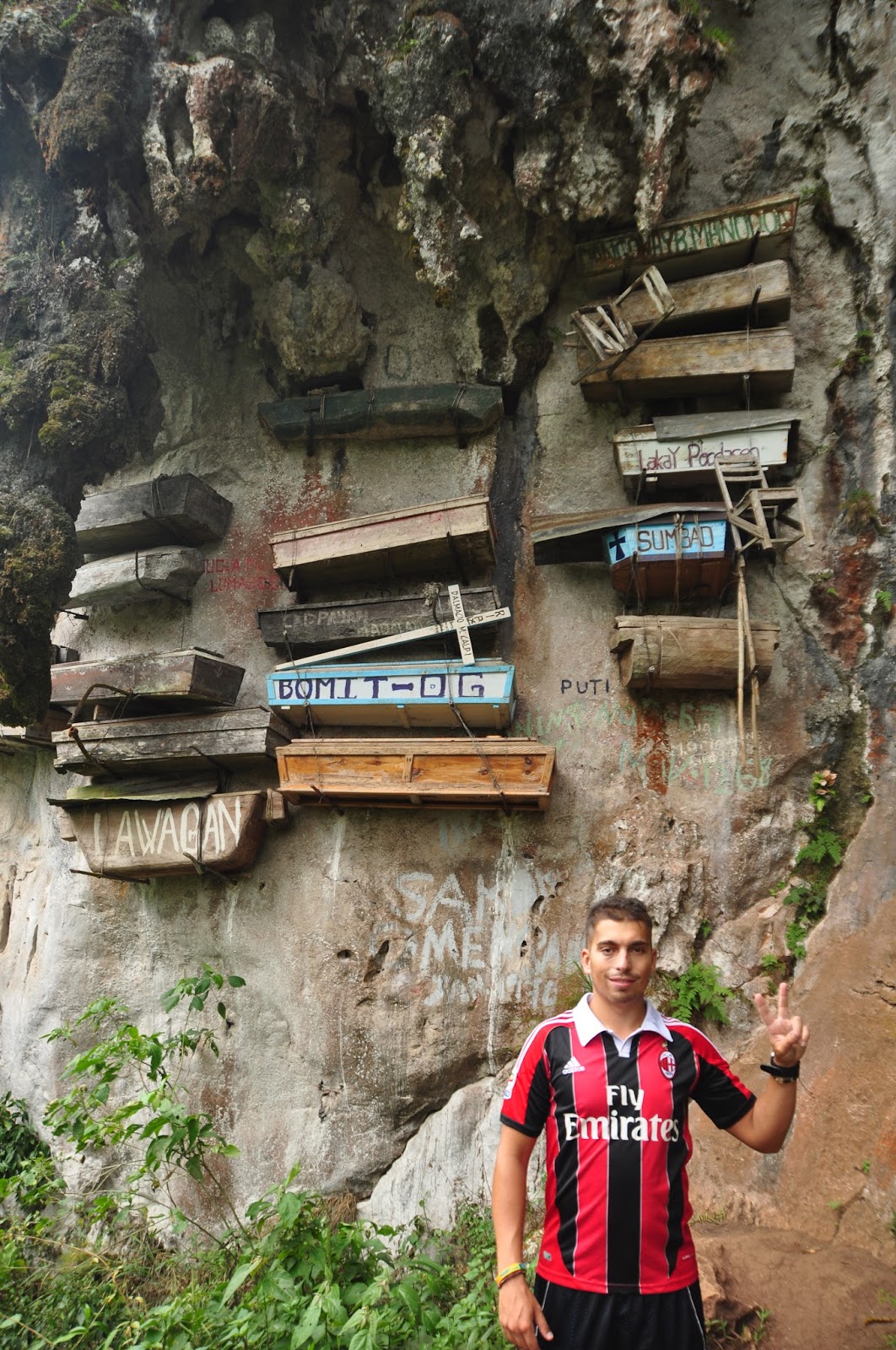
Another interesting observation is that the coffins were around half the size of what we would consider normal sized adults. While I know Filipinos are among the shortest people in South East Asia, this was a little extreme. Then we thought that perhaps they only buried children in this manner, but that was also misguided. It turns out that people in this tribe buried their dead in the foetal position because they believed that they should leave this world as they entered it. Pretty amazing concept.

One of the highlights of our time in Sagada (at least for me) was Bana's cafe: a local cafe with balcony overlooking a gorge and coffee plantation. Not only did they have a beautiful view, but some of the best coffee I've had since Vietnam.

It was already time to leave wonderful Sagada, and also drawing closer to the time where Mike would no longer be my travelling partner.

We took a jeepney to Bontoc, a sleepy little transit town where I saw a woman with two thumbs. From there, we continued onto Banaue, our intended and final destination on our Philippine adventure. The scenery on this ride, and in the Cordillera region as a whole, was absolutely fantastic.

We arrived in the afternoon and checked into Uyami's Green View Lodge. The room we had was decent, but the view from the lodge's balcony was simply breathtaking. I must have taken a picture of that view with every possible lighting imaginable.


Banaue is the base for exploring the Ifugao rice terraces. These ancient rice terraces were built and carved into the mountains of the Ifugao mountains over 2000 years ago. They have been called the 8th wonder of the world by some (probably Filipinos), and are a UNESCO World Heritage Site since 1995.

The Banuae rice terraces are featured on the 20 peso banknote but while researching for this post, they are not on the UNESCO list because of the modern reparations made to these ancient structures. UNESCO is obviously very difficult to please. I still find them immensely impressive.


Mike and I took a jeepney to Banaue's famed lookout point and took it all in. We had the great idea that instead of walking down the road like suckers we would walk through the terraces on our way back towards the town. It was all downhill so that should have been fairly straightforward. At least we thought it would be.

Every time we thought we were going in the right direction, we ended up at a dead end or impenetrable pass. It eventually became quite frustrating trying to figure out how to get down.

Because it is still actively used in farming in this region, many of the terraces are submerged in water. While I motioned for Mike to step out onto the edge for an epic pic, he tried to step around me, and instead stepped into a huge puddle of mud and was knee deep in it. I laughed accordingly.


After wandering onto private property more times than we intended, we finally made it back onto the road down to Banaue, and just in time too, because it started absolutely pissing rain.


The following day we arranged to do a trek from the Banaue region to Batad, one of the actual UNESCO rated rice terraces.

The walk there was absolutely stunning. Not only did we get to see the entire region only accessible by foot, but we also had a local guide who made sure that we didn't get lost or wander onto people's land.

When we finally got our first glimpse of Batad, Mike and I were literally speechless. That's rare for Mike. He never shuts up. I would go in to a description, but I think the picture speaks for itself.


We stood and gazed at this marvellous mixture of natural and man-made wonder. Our guide then asked if we wanted to visit the Tappiya waterfall. Since it was hot as balls, we thought it was a no-brainer.

It was a piece of cake because it was all downhill and when we saw the impressive 30m falls, we could not have been any happier.

Seeing as though I was happy, Mike decided to rain on my parade. I asked if he could take a picture of me standing in front of the falls. Since he was already making his way into the water, he bluntly declined. The result is that weird angle shot of me using a self-timer and rock for balance. I can distinctly remember at that moment that I was happy he was leaving the next day.


That wasn't true. His time to leave the Philippines and his role as my travel buddy had finally come to an end. Our three-and-a-half month adventure through 5 countries (Vietnam, Malaysia, Singapore, Myanmar and the Philippines) had gone swimmingly well. The non-stop laughs and wise-cracks made this portion of my journey unforgettable and hilarious. Mike and I have travelled several times before this trip, and I hope we will continue to meet up elsewhere in the world in the future as well.


On my final day in the Philippines, I met an American traveller named Jeff and we did some small hikes between the villages of Tam-an, Poitan and Bocos. It was fun, but I was already missing Mike.


Now that I had reached my final day in the Philippines I can honestly say that this country blew my mind and exceeded all of my expectations (except for the food, I didn't find it anything special). I have barely scratched the surface of this 7000-island nation in the month-and-a-half that I was there. I decided that the best way to get over my sadness of not visiting every island, was to visit a country with 10,000 more islands than the Philippines. Next stop: Indonesia!
  

Saturday, December 31, 2016

Malaysia: The Mook has Landed!

March 29th-April 4th

As I made my way to Saigon's public bus terminal through the ever-bustling Cong Vien Van Hoa Park, I stopped when I noticed a Caucasian jogger coming towards me. I couldn't believe it, but it was John, an American I had met on my first day in Cairo. He was currently living in Ho Chi Minh City and training before he went to a Muay Thai camp in northern Thailand the following month.

It had been over 8 months since we had initially met and to see each other at this exact time and place really blew our minds. It never ceases to amaze me how small our world really is!

I then took the bus to my stop and thanks to a Vietnamese pilot also headed for the airport, I was ushered to the connecting bus to the international terminal.

My next destination was peninsular Malaysia to reunite with Mike following his travels in Cambodia and to meet up with my friend Yagil.

Yagil and I have been friends since Cegep (Quebec College), and I personally take credit for introducing him to the wonderful world of partying.

Since that time, we have studied together at McGill University in Physical Therapy; and travelled together to Niagara Falls, New York City, Boston, North and South Carolina; and even in Turkey.

He was looking for an exotic location and I thought Malaysia would be a suitable place to meet up because it has beautiful beaches, historical landmarks, outdoor activities; while still having good infrastructure and western amenities that would not throw him too off guard.

While Yagil and I are very different travellers: I prefer backpacking and he prefers more luxurious holidays; we decided to compromise and find things that pleased us both.

Good Luck!

Our first stop was Palau Langkawi, peninsular Malaysia's duty-free island, and closest thing Malaysia has to a party spot.

Even though the three of us were flying in from different countries, we all had a seat booked on the flight from Kuala Lumpur to Langkawi.

We arrived to Langkawi after dark and took a taxi-van to Zackry Guest House on Pentai Tengah. We then moved our stuff into our private room and joined some other guests for some beers.

Malaysia, being a moderately conservative Muslim country, has comparatively high taxes on alcohol and as a consequence, it is quite more expensive to drink than in the rest of South East Asia.

However, Langkawi has had a duty-free status since the 80's to increase tourism and as a result is the cheapest place to drink in Malaysia.

Party on!

After eating dinner and listening to the Malay-Samoan-Kiwi hostel employee run his mouth for over an hour, we made our way to a beach-side bar/club before heading to Sunba Retro Bar, a packed place with a really decent band.

The next day, after a late breakfast, we joined Andreas, a German traveller, and took a taxi to Langkawi's impressive cable-car located at Gunung Mat Chin Chang.


Despite my aversion to cable-cars in China, this one allowed us to see spectacular views over the archipelago of 99 islands and even see Thailand from the top!


We then went to Seven Wells, a series of natural pools where we could cool off after climbing the hundreds of stairs to get to them. We also spent a brief time watching locals flipping into the pools trying to impress us.

On our way back, we were fortunate enough to witness fighter jets flying overhead because our time in Langkawi coincided with an airshow. Pretty cool stuff!

After spending the rest of the afternoon at Tengah beach, we partied with the best of em after playing drinking games at the hostel and then hitting up the same places as the night before, only in reverse order.

We had an evening boat to catch so we spent our last day in Langkawi on the surprisingly beautiful Pentai Cenang. To be honest, I think that this beach was the best maintained and pristine since arriving in South East Asia. Sorry secret beach in Koh Rong, you've been knocked down a spot!


 Andreas joined us on the ferry to Penang, our next island destination on Malaysia's west coast. The ferry itself only took 2 hours and then we proceeded to walk through the historic centre of Georgetown to get to our heritage-home guest-house, Red Inn Heritage (redinnheritage.com).


Despite most restaurants being closed, we still managed to find one of Malaysia's famous Hawker stalls: pretty much a late-night food court selling some of the best and cheapest food that Malaysia's Malay, Chinese and Indian inhabitants have to offer.

Georgetown, located on the north-eastern coast of Pulau Penang was founded in 1786 by the British and was one of their three initial straights settlements with Melaka and Singapore. It has been a UNESCO World Heritage site since 2008 and still has many of its historic buildings and charm intact.

We commenced a self-guided walking tour, passing the cathedral of the assumption and St. George's church, said to be the oldest Anglican church in Southeast Asia, having been built in 1817.


We then spent an hour in the Penang State Museum to get a history lesson about Georgetown and its multi-ethnic population.

A short walk down the seaside esplanade led us to the remnants of Fort Corwallis and the city and town halls.

The next part of the tour brought us through Chinatown with its narrow, ornate alleyways and some beautiful street art.


We visited the beautifully decorated exterior and uninspiring interior of the Hainan Temple built in 1895, strolling past the Masjid Malayu Lebuh Acheh, built for Georgetown's Arab settlers.

We then stumbled across Khoo Kongsi, a fantastically decorated clan house belonging to the Khoo Kongsi Klan, who we hilariously convinced Yagil started the KKK in North America.


This building gives most temples in China a run for their money. Really really impressive.


Our next stop was the Kapitan Keling Mosque, which we weren't allowed in due to our status as infidels.

We had some delicious samosas in Little India before visiting the Goddess of Mercy Temple and strolling back along the quaint streets of Georgetown before reaching our guesthouse back on Love Lane.

A hostel employee had promised us a free tour of Penang the following day, but had slept until noon and completely forgot about us. We decided to visit Kek Lok Si Temple, the largest temple in Malaysia instead.

The complex is located on a hill and is as imposing as it is beautiful. To reach the seven-storied Ban Po Thar Pagoda, we had to walk up several staircases, past turtle ponds and hundreds of Buddhas.


After, we took a cable car to the immense 36.5m bronze statue of Kuan Yin, housed in an even larger frame. This was the first time I actually heard Mike say something actually impressed him. From up there we got some nice views of Air Itam and the surrounding hills.


Yagil and I arranged to take a night bus to Kuala Besut, the launching point to the spectacular Perhentian Islands. The bus we got was spacious and incredibly well air-conditioned. It didn't even matter that we had to share it with a group of travelling American Christian Missionaries.

Things were too good to be true when halfway through we had to change buses because of an air-con problem obviously felt by everyone but us, and we were put on another bus with way worse air-con and who dropped us off in Kota Bharu, a two-hour drive from Kuala Besut!

We were forced to pay for a taxi with a German guy which dropped us off at our intended destination. The only consolation was the absolutely incredible sunrise we saw over Kuala Besut.


Eventually, we caught a speed boat to Palau Kecil and settled into our long beach accommodation. It was hilarious to watch Yagil's reaction to every wave we hit on our surprisingly fast boat.

The Perhentian Islands are blissful, laid-back backpacker havens. Their beautiful beaches and shisha/fire-show evenings were beyond divine. The Perhentians, much like Thailand's Koh Tao, are renown for cheap and beautiful diving.


Our first day consisted of us chilling out at Long Beach and me trying to teach Yagil how to snorkel. My instructing him consisted of telling him to breathe through his mouth while keeping his head underwater. That's all there is to it!


The next day, Mike and I went diving with Turtle Bay Divers (www.turtlebaydivers.com), where after countless attempts, I finally saw sharks while diving in Southeast Asia! I saw a coral cat shark and a black tip reef shark. Take that Koh Tao!

That afternoon I did a snorkeling trip with Yagil and saw turtles, black tip reef sharks and it was successful because Yagil didn't drown and I didn't have to rescue him!

Our final night we went to Coray Bay for dinner and enjoyed another relaxing evening on the beach.


Because of Yagil's relatively short schedule (only 12 days), this portion of our trip together was the slower, more laid-back part, allowing us to stay a mere 2 nights in each place. From here, we would only be staying in each city for one night before heading to the next one.

Let the race begin!


Wednesday, December 14, 2016

The Spared City and Little Moscow

March 11th-18th

A relatively quick bus ride (by Southeast Asian standards) from Hue dropped us off in Hoi An, our next stop in Vietnam. A shuttle was waiting for us and brought us to our hostel, the impressive Sunflower Hotel (http://sunflowerhotelhoian.com/). Not only did this place serve a tremendous, buffet-style breakfast; but it also had a huge pool area to swim and mingle.

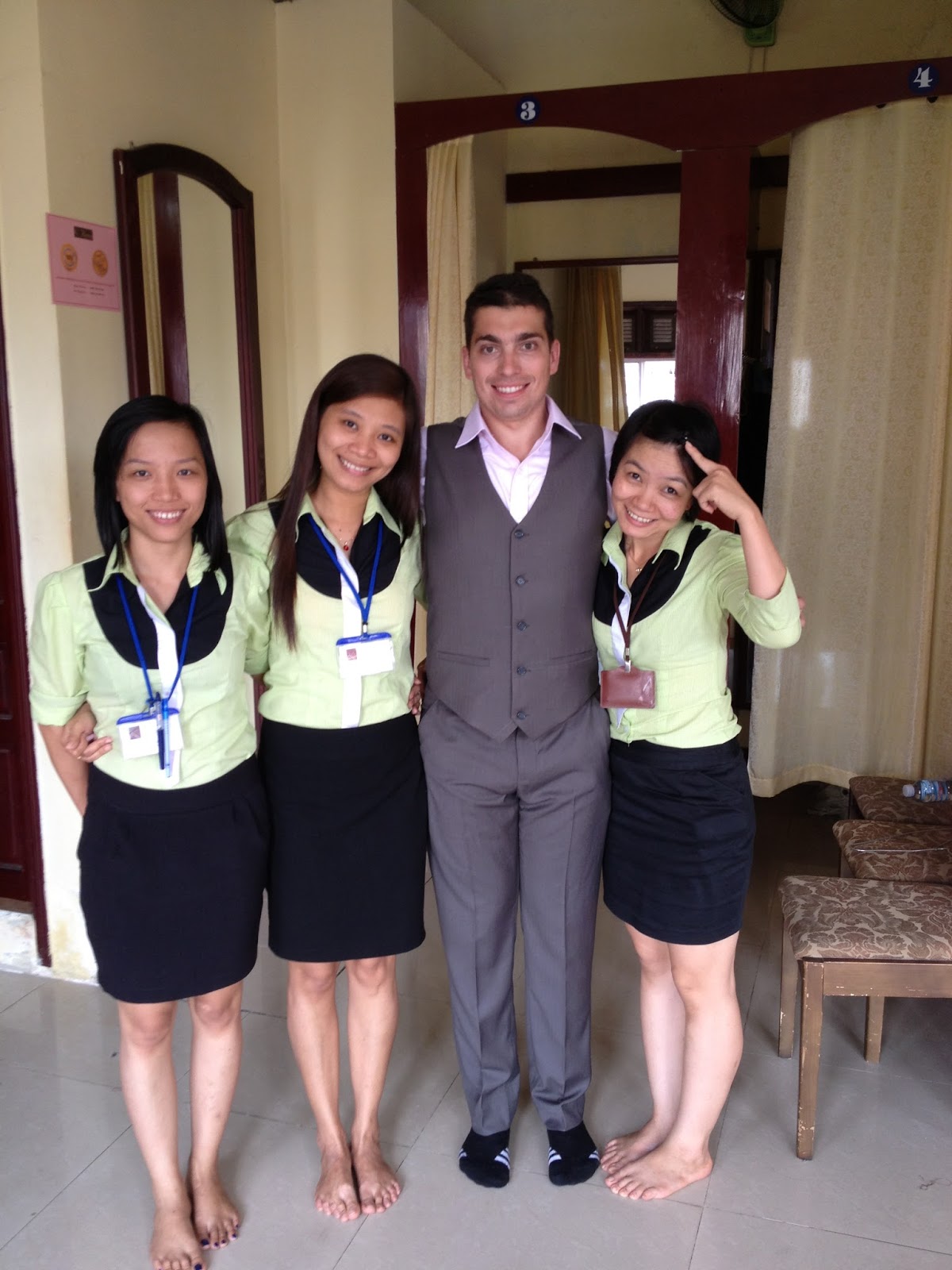
Hoi An, while known for its architecture and historic Old Town (more on that later), is also renown in Vietnam for its hundreds of tailors, making this THE place for all your custom-made suit needs. Knowing that getting a custom-made suit will likely take several days and require numerous re-fittings, Mike and I made it our number one priority to locate a reputable tailor and start the process as quickly as possible.

After some research and recommendations from other travelers, we agreed on Kimmy's (http://www.kimmytailor.com/) and were rather blown away by their customer service and attention to detail. The first step was choosing the fabric. This included the main fabric choice as well as the inner lining. We then went through a laptop with literally hundreds of different styles, both original and others taken directly from pictures off of major fashion house runway shows or photo-shoots (i.e. D&G, Armani, etc). After this thorough yet tedious process, we were measured. I have never had custom-made clothing before, but they took measurements of things I wasn't even aware needed measuring.


Despite the rigorous initial measuring process, we were still required to return to Kimmy's another 3 times over the next few days for re-fittings, to make sure the suit fit like a second skin. To be honest, it was probably even better (tighter) fitting than my actual skin, seeing as though I couldn't really sit comfortably, nor hug myself, nor raise my arms above my head, but holy shit did I look sexy!


If it's better to look good than to feel good, I considered this a mission accomplished.

Once we had the suit situation under control, Mike and I decided to rent motor bikes and head to the archeological site of My Son. My Son has been called "the Vietnamese Angkor Wat" by some, but those people have probably never seen the actual Angkor Wat in neighboring Cambodia.

Not. Even. Close.

The first part of the adventure was just getting there. My Son is located 55km from Hoi An, and in order to get there you need to navigate country roads, highways and poorly marked turnoffs.

Driving down the highway on a motorized scooter being passed by trailer trucks with little to no regard for human life sounds exhilarating, but actually turned out to be quite terrifying.

We did eventually and thankfully make it to the site with our lives intact.  

My Son was once the most important religious site for the Kingdom of Champa, an empire based in present day Vietnam who thrived in between the 2nd and 15th centuries.


The Champa kingdom were initially Hindu, using Sanskrit in their sacred writing. The Indian influences upon their culture and architecture were very apparent upon exploring this ancient site.


In present day Vietnam, the Cham people, or the descendants of the Champa Kingdom, remain a prevalent visible minority, however they are principally Muslim now.


The site originally contained 68 structures, but now only 20 remain. The site was almost completely destroyed by American bombardment in the Vietnam War.


Despite the small stature of the site and crumbling architecture, Mike and I still enjoyed exploring the ruins. We were promised large crowds, but the high heat and humidity likely kept the other tourists away and gave us a peaceful and unique experience.


How often do you get to explore a UNESCO World Heritage Site virtually alone?

Not very often.

The following day we decided to explore the old town of Hoi An. The unique architecture and history of the Old Town have given the city UNESCO World Heritage status since 1999, and to visit many of the buildings it requires a tourist ticket and an appreciation for cool dragon statues.

Check and check.

Hoi An was initially the principle sea port of the Champa Empire, dating back to the 2nd to 10th centuries. By the 15th century, it had become one of the most important trading ports in South East Asia, attracting merchants from all over the world.

Many different wares were sold here, including world famous silk, which would theoretically explain the over-abundance of tailors in present day Hoi An, but I don't think it's actually related.

This history of foreign merchants and consequently seasonal occupants, has led to the unique architectural landscape present in the Old town.

Some popular tourist attractions and remnants of Hoi An's merchant past are the Japanese Covered bridge, probably the most iconic structure in Hoi An.


As well as numerous Chinese temples and assembly halls.


The architectural diversity, the beautiful scenery hugging the Thu Bon river, and the ban on cars and motor bikes within the old city; make it a truly beautiful place to wander and explore, albeit with hundreds of other tourists.   


What sets Hoi An apart from other places in Vietnam is that it is still in much of it's original, non-rebuilt, architectural splendour. In the 18th century, Hoi An lost out as a major trading port against nearby Da Nang and because of this, it consequently became just another sleepy river-side town, and it was spared American bombing during the Vietnamese war. Lucky them.


The whole old city is accessible on pedestrian roads and if you want to enter some of the buildings you can purchase a pass from the tourist bureau.

As we were walking back from our stroll in ancient Hoi An, a goddam motorbike turned right into me and slammed me in the ribs with the handle bars, managing to pinpoint the exact location that I had injured on the ridiculous tubing accident in Ha Long Bay.

Thankfully, Hoi An actually had a pretty incredible night life to ease my rib pain, which included such great bars as Why Not? bar and Volcano bar, which required a 5$ entrance fee for all you can drink vodka and western meatheads playing Youtube videos on a giant projector screen!

On our way back from Volcano, Mike and I hailed a motorcycle taxi that literally scared the sobriety back into us. The bike took corners like the way they do in MotoGP and we could feel the pavement graze our bare legs as we hovered mere centimeters from the ground.

On our final day in Hoi An, we decided to visit Cua Dai Beach, just a few kilometers from the city center. The sand was great, the water was warm and this was the only place in Vietnam I would wear my conical hat in public. Unfortunately I have no photographic evidence of this.

Our next stop was Nha Trang, which we arrived at after yet another long night bus ride.

Nha Trang is less known for its history, but more for its beaches. It is a major tourist destination for a surprising amount of Russians. As the story goes, during the cold war era, the Russians and Vietnamese were strong allies and well-off Russians who wanted to get away from the Siberian winters were able to get direct flights to Nha Trang, where they could bask in the heat, enjoy the beach, and drink the vodka. Apparently, the attachment to this city still carries on today.


The Russian influence, at least in the center of the city is still very evident. Russian text is on store fronts and flags are on buildings and Russian is being spoken.

Other than having a low-key celebration of St. Patrick's Day at a local Irish pub, Mike and my activities consisted of beaching it up and avoiding Russians.

I had to extend my Visa and Mike wanted to check out the south of Vietnam before his visa expired, so I would be staying behind while he would trek solo towards Saigon, where we would be meeting up again in a few days.

A Beautiful beach and Mike-free time. Sounded like heaven on earth.