Showing posts with label Asia. Show all posts

Sunday, February 12, 2017

We. The North.

June 4th-June 12th

Our time in the central islands of the Philippines had come to an end. We woke up at the break of dawn and were shuttled to Coron's airport in the middle of nowhere. Our morning flight would be bringing us back to Manila and back to the island of Luzon, where we would be heading to the north of the island for our final time in the Philippines.

Once back in Manila, we immediately made our way to the bus station and hopped on a bus headed north to Vigan, our first destination. Even though Vigan is 405km away from Manila, the mountainous roads of the Cordillera region made the drive slow and it took us between 7-10 hours to finally get to our destination.

We arrived after dark and hadn't made any reservations. We took a taxi to the area where our desired accommodation was located and hoped for the best. The door was locked and we had to wait outside until someone opened up the door. Thankfully, they had one room left and I jumped on the opportunity. It was considerably fancier than the places we were used to and was a heritage building.

Vigan, not to be confused with those non-animal-based-product-eating hippies, is a city that was captured and settled by the Spanish in 1572. It grew in power and influence and became the seat of the Diocese of Nueva Segovia in 1758. It was spared from bombing in World War II and as a result, Vigan still maintains much of its original colonial charm; including cobble-stone roads, Spanish-era villas and also uses kalesa (horse drawn carriages) as well as trikes.


Because of this high degree of preservation, it was named a UNESCO World Heritage Site in 1999, being the best preserved Spanish colonial town in all of Asia.

We started our day just sauntering through the cobble-stoned streets and admiring the colonial architecture. We eventually came across a small nondescript church with an extravagant graveyard behind it.


It was surprisingly interesting to wander around and see the elaborate crypts, tombs and tombstones.

From there we went to Plaza Burgos, a tribute to Father Jose Burgos. This was right across the street from St. Paul's Cathedral and the Archbishop's Palace.


From there we passed City Hall and stopped to take some pics in front of the Plaza Salcedo and its impressive fountain.


Our next stop was the most interesting of the day: the Provincial Jail. This colonial-era building was still in use but could also be visited by tourists. We assumed it wasn't for dangerous offenders because we got to tour a basketball court and saw a large group of prisoners watching TV.


After a great breakfast at our hotel, we headed for Baguio, our layover stop before heading deeper into the Cordillera region of Luzon.

Baguio is a bustling university town and was founded as a hill station for the US military in the early 1900s.

We arrived near nightfall so the landscape was rather obscured, but two things were for sure: 1) Baguio was extremely hilly (there were no trikes to be seen) and 2) there was a ton of traffic.

We settled on a place called Blue Mountain Hotel and were eager to have a night on the town. Being a university town at the very beginning of the semester, we expected the night life to be the stuff of legends.

We started our evening by eating at Cafe by the Ruins. This restaurant was a little more high class than we were used to, but the food and the ambience were second to none. We ran into a little problem when we ordered drinks with our meal, because the waiter informed us that they didn't serve alcohol.

Being extremely resourceful, Mike went off into the night and procured us a 6-pack and came back into the restaurant. The waiter saw, and was not impressed. We stated that we would have gladly purchased them from the restaurant if they had offered them. After some friendly exchange, he finally agreed, but told us we would have to drink it from nondescript glasses. Fair enough.

We had heard about a really popular student bar district and we decided to find it. For some reason (most likely frugality), we decided to walk and find it rather than take a taxi. We walked around for probably over an hour until we finally stumbled upon this mecca of partying.

Unfortunately, the 3-4 bars in this complex were virtually empty! It turns out that we had in fact showed up one week too early for the beginning of the semester, and as a consequence, missed all the first-week shenanigans.

We did finally go into one bar jam-packed with 4 other people, including one not so convincing lady-boy, and I ended up dancing on stage with everyone while Mike took pictures of this sorry spectacle.

The following day, were were off to Sagada, the Cordillera's natural wonderland. It has been alluring us with caving, hiking, waterfalls and fascinating hanging coffins (more on that later), but first we had to get there.

We took an almost 6-hour bus ride from Baguio to Sagada. Considering it is only 150km away, you can imagine the condition of the roads and the speed of the bus. However, the mountainous landscape really makes up for it.

We finally arrived to Sagada and were blown away by the quaint atmosphere and chill vibe that this place radiated.

We found a guesthouse near the bus station and started to explore. We had three goals for Sagada: to go caving, see hanging coffins and chill as much as humanly possible. Our first afternoon and evening, we did the third one hard.

The next day we arranged to do the cave connection, which is caving where you start at Sumaguing cave and finish at Lumiang cave, never coming to the surface in between.

At the caving office, it recommends that people who were out of shape or fat should not attempt this rigorous excursion, but we were two svelte young studs so we thought it would be a piece of cake.


Near the entrance of the first cave we saw what appeared to be a pile of coffins. At a closer glance, it was in fact a pile of coffins. Apparently the ancient inhabitants of these lands keep their dead near the mouth of the cave in order for them to "see the light" and be directed to heaven.


From there it got progressively darker, and we were now fully in the cave and would have to rely on our guide to get us out of there in one piece.

We passed many stalactites and stalagmites and many other rock formations. Some of these included a pseudo maple leaf that brought a patriotic tear to our eyes, as well as a rock formation that really resonated with the environment: that being dark, tight and wet.


We were underground for a few hours before finally approaching the opening of Lumiang cave. It was quite spectacular being able to traverse the earth without seeing the light of day for so long.


Once outside, I posed next to our first taste of the region's famed rice terraces with our guide and we made our way back to Sagada.


Once back to Sagada, we were immediately in search of the famed hanging coffins. The ancient inhabitants of this region, the Igorot tribe, have been doing this ritual for hundreds if not thousands of years. It was believed that it was done in order to keep the bodies closer to the spirits, but others speculate it could have been done to prevent ground water from seeping into the coffins or more interestingly, for keeping the coffins away from rival head-hunting tribes who would come in search of trophy heads.
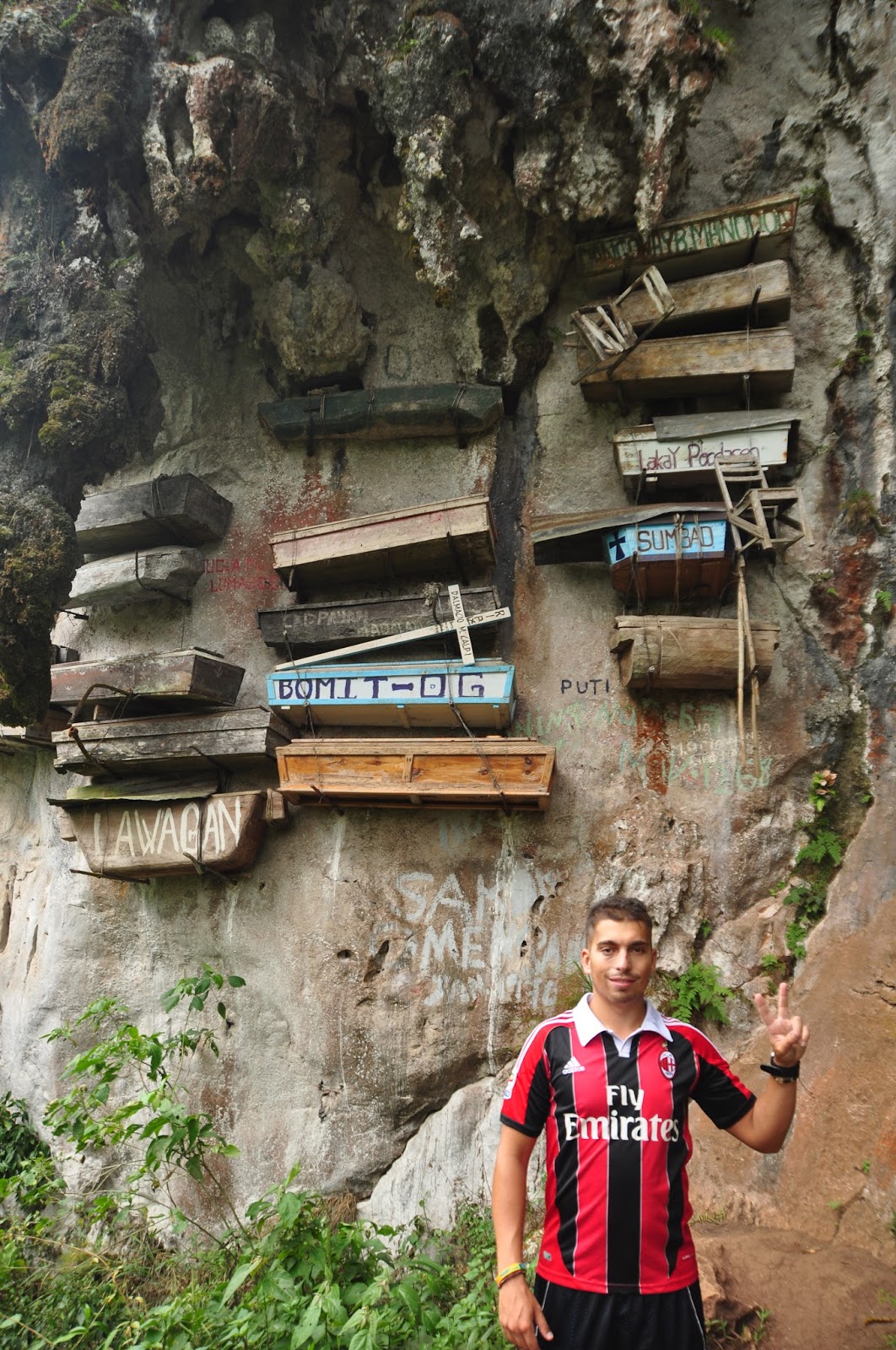
Another interesting observation is that the coffins were around half the size of what we would consider normal sized adults. While I know Filipinos are among the shortest people in South East Asia, this was a little extreme. Then we thought that perhaps they only buried children in this manner, but that was also misguided. It turns out that people in this tribe buried their dead in the foetal position because they believed that they should leave this world as they entered it. Pretty amazing concept.

One of the highlights of our time in Sagada (at least for me) was Bana's cafe: a local cafe with balcony overlooking a gorge and coffee plantation. Not only did they have a beautiful view, but some of the best coffee I've had since Vietnam.

It was already time to leave wonderful Sagada, and also drawing closer to the time where Mike would no longer be my travelling partner.

We took a jeepney to Bontoc, a sleepy little transit town where I saw a woman with two thumbs. From there, we continued onto Banaue, our intended and final destination on our Philippine adventure. The scenery on this ride, and in the Cordillera region as a whole, was absolutely fantastic.

We arrived in the afternoon and checked into Uyami's Green View Lodge. The room we had was decent, but the view from the lodge's balcony was simply breathtaking. I must have taken a picture of that view with every possible lighting imaginable.


Banaue is the base for exploring the Ifugao rice terraces. These ancient rice terraces were built and carved into the mountains of the Ifugao mountains over 2000 years ago. They have been called the 8th wonder of the world by some (probably Filipinos), and are a UNESCO World Heritage Site since 1995.

The Banuae rice terraces are featured on the 20 peso banknote but while researching for this post, they are not on the UNESCO list because of the modern reparations made to these ancient structures. UNESCO is obviously very difficult to please. I still find them immensely impressive.


Mike and I took a jeepney to Banaue's famed lookout point and took it all in. We had the great idea that instead of walking down the road like suckers we would walk through the terraces on our way back towards the town. It was all downhill so that should have been fairly straightforward. At least we thought it would be.

Every time we thought we were going in the right direction, we ended up at a dead end or impenetrable pass. It eventually became quite frustrating trying to figure out how to get down.

Because it is still actively used in farming in this region, many of the terraces are submerged in water. While I motioned for Mike to step out onto the edge for an epic pic, he tried to step around me, and instead stepped into a huge puddle of mud and was knee deep in it. I laughed accordingly.


After wandering onto private property more times than we intended, we finally made it back onto the road down to Banaue, and just in time too, because it started absolutely pissing rain.


The following day we arranged to do a trek from the Banaue region to Batad, one of the actual UNESCO rated rice terraces.

The walk there was absolutely stunning. Not only did we get to see the entire region only accessible by foot, but we also had a local guide who made sure that we didn't get lost or wander onto people's land.

When we finally got our first glimpse of Batad, Mike and I were literally speechless. That's rare for Mike. He never shuts up. I would go in to a description, but I think the picture speaks for itself.


We stood and gazed at this marvellous mixture of natural and man-made wonder. Our guide then asked if we wanted to visit the Tappiya waterfall. Since it was hot as balls, we thought it was a no-brainer.

It was a piece of cake because it was all downhill and when we saw the impressive 30m falls, we could not have been any happier.

Seeing as though I was happy, Mike decided to rain on my parade. I asked if he could take a picture of me standing in front of the falls. Since he was already making his way into the water, he bluntly declined. The result is that weird angle shot of me using a self-timer and rock for balance. I can distinctly remember at that moment that I was happy he was leaving the next day.


That wasn't true. His time to leave the Philippines and his role as my travel buddy had finally come to an end. Our three-and-a-half month adventure through 5 countries (Vietnam, Malaysia, Singapore, Myanmar and the Philippines) had gone swimmingly well. The non-stop laughs and wise-cracks made this portion of my journey unforgettable and hilarious. Mike and I have travelled several times before this trip, and I hope we will continue to meet up elsewhere in the world in the future as well.


On my final day in the Philippines, I met an American traveller named Jeff and we did some small hikes between the villages of Tam-an, Poitan and Bocos. It was fun, but I was already missing Mike.


Now that I had reached my final day in the Philippines I can honestly say that this country blew my mind and exceeded all of my expectations (except for the food, I didn't find it anything special). I have barely scratched the surface of this 7000-island nation in the month-and-a-half that I was there. I decided that the best way to get over my sadness of not visiting every island, was to visit a country with 10,000 more islands than the Philippines. Next stop: Indonesia!
  

Wednesday, January 18, 2017

Angkor Who?

April 25th-May 1st

We arrived at yet another ungodly hour in the morning to Mandalay, Myanmar's second city. From the bus station we caught a cab that brought us to our hotel. I distinctly remember tailing a delivery truck with its flatbed open and 2 young men sleeping in the back with their heads literally hanging over the edge, just a foot from the ground. One thing is for sure, South East Asians can sleep anywhere, anytime, and in any situation.

For some reason that is beyond me, night buses in Myanmar always leave in the late afternoon, at around 4-6pm. The roads used to be in extremely poor condition and the buses would arrive in the morning. Now that the roads have been drastically improved, these same buses usually arrive at 3-4am when visibility is at an all time low and finding accommodation and getting your bearings is extremely difficult.

We took a lot of night buses not only because we are cheap and wanted to save on accommodation, but because our 15 day time period in Myanmar was just, and I mean just, enough time to fit in everything we wanted to do. If I were to do it again, and if you were to do the same itinerary as we did, I would definitely recommend at least 3 weeks, with time to really enjoy each city and to interact with the people.

After getting some early morning shuteye, we were already on our way to our first stop of the day: Mandalay Palace and Fort. Our hotel wasn't located that far from the fort, but since the only entrance open to foreigners is the east one, we ended up having to walk quite a distance to get there. I haven't really been mentioning this, but we were smack right in the middle of the hot, dry season. If you think that it is always hot in South East Asia, then you are correct, but this time of year is in fact the hottest. So unnecessary walking is not always welcome.

Mandalay was the capital of the Burmese Empire in 1861, and remained so until the British took it over in 1885. Mandalay is the only Burmese city that seems somewhat like an actual city, due to the continual investments of the Chinese.


The fort and palace itself are actually reconstructions because they were burned to the ground during the second world war. The interiors of these buildings aren't very impressive, but the sheer scale and the exterior architecture of the complex was.


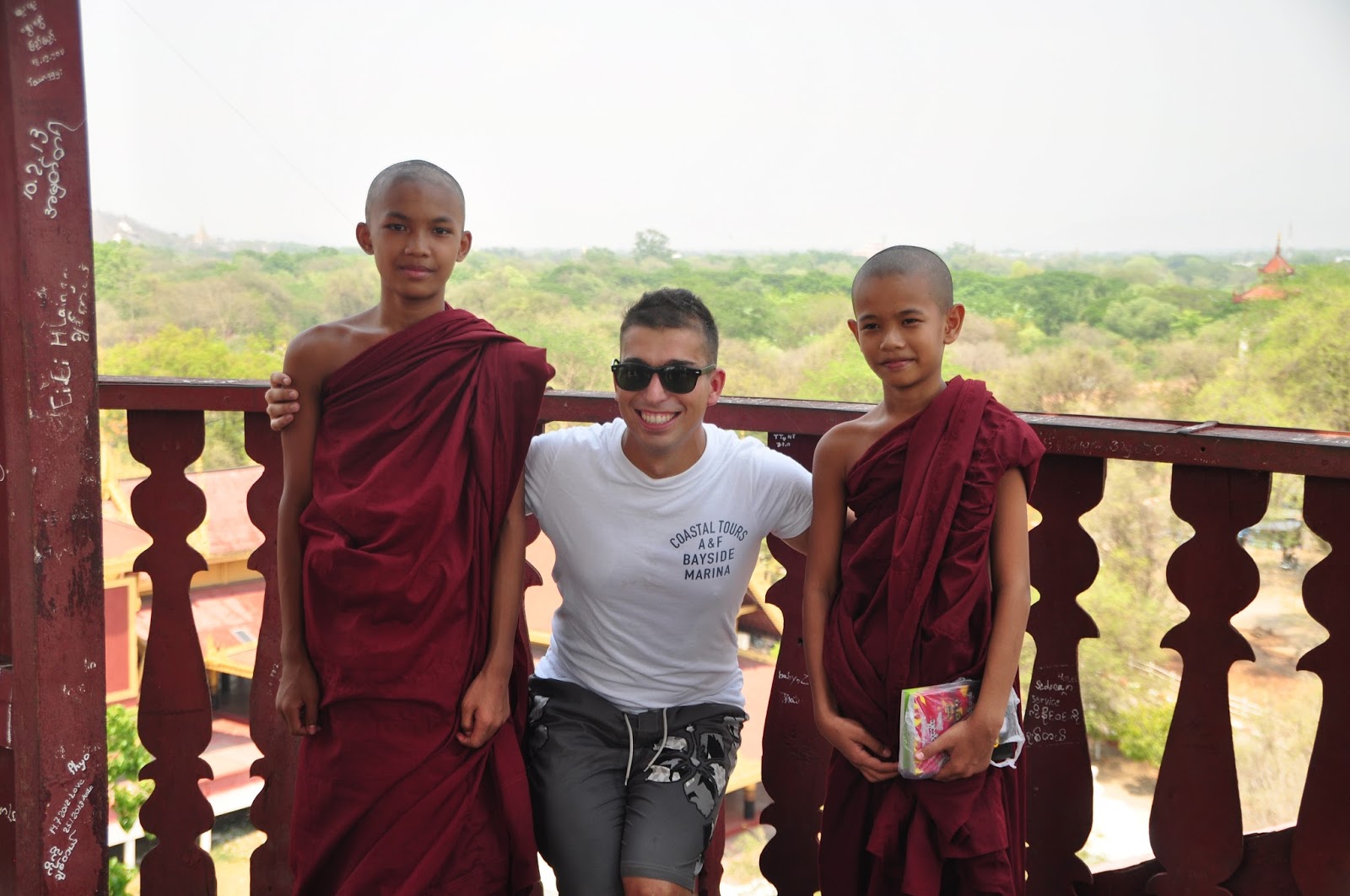
The highlight of our time at the palace was happening upon a group of young monks at the top of one of the towers. We took pictures with the group and it made these otherwise mediocre interiors worthwhile.


After wandering around the monstrous grounds and grabbing a beverage to cool down, we made our way to Kuthodaw Paya.


The golden pagoda looks quite similar to the other pagodas we have seen so far, but this temple is distinguished by the fact that each one of the surrounding white kyauksa gu (stone inscription caves) contains a stone slab detailing 2 pages of the tipitaka (the Pali Canon of Theravada Buddhism).


There are a total of 729 of these caves and this is recognized as the world's largest book. I was just admiring the contrast between the golden central stupa and the pristine white structures surrounding it.

Our final stop of the day was Mandalay Hill for sunset. To reach the top of this 230m view above the surrounding plains, you have to climb up stairs for 45 minutes (I'm not sure how the math adds up but either way it's well worth it). Because it is a sacred place, you have to do it barefoot.

On top, we were treated to a beautiful view over the Shan hills, the Ayeyarwady River and the palace grounds.


We spent a while here enjoying the view and letting the sweat on our backs dry from the gruelling climb.   

 The following day we started off visiting Shwenandaw Kyanug Monastery which has the distinction of being built entirely out of wood. It is also the only remaining part of the original Mandalay Palace.


After, we made our way to Mahamuni Paya, whose main draw is a 4m-tall Buddha statue that is covered in 15cm of gold leaf due to the degree of veneration the population has for it.


In this same complex are several pillaged artifacts from Angkor Wat in Cambodia. If you'll notice in the photo, I'm wearing what looks like a skirt. It is called a Longyi, a Burmese sarong that most men wear in everyday life. I eventually bought one and would frequently ask hotel staff to teach me how to tie it properly, although it would still frequently loosen or fall off. When in Myanmar.


That afternoon we would be visiting a series of ancient cities on the outskirts of Mandalay. The first one was Sagaing. What really sets this city apart is its location. Built upon rolling hills, from the top it is remarkable to see all the stupas dotting the surrounding area.


The only downside is that all of these stupas require you to remove your footwear and I literally had to run around them because my tender western feet could not handle the heat generated by some of the stone tiles.

Our next stop was Inwa, or Ava, which was a former capital of Burma from the 14th-16th centuries. This to me was the highlight of the day. We were brought around to crumbling ruins by horse-drawn carriage, although it was more of a cart, and explore the rural country side.


We stopped to explore numerous ruins, some so decrepit you would have no idea that they were once majestic royal architecture.


One of the signature temples we stopped at was Bagaya Monastery, a teak structure built in 1834 and supported by 267 posts.

From there we saw the Nanmyin watchtower in the distance, before finally stopping at the Maha Aungmye Bonzan, a beautiful brick and stucco monastery from 1822. I thoroughly enjoyed this building due to its colours. What I didn't like and the only time in Myanmar I experienced this, was young children following us the entire time repeating "money" over and over and over again. I really hope that the people of Myanmar don't turn to begging with the increased influx of tourists.


Our final stop of the day was Amarapura, or the City of Immortality. This city is famed for U Bein 's Bridge: its 200 year old, 1.2km teak bridge. This was the perfect final stop to a perfect day in the region surrounding Mandalay.


The following day we took a "night bus" and ended up in Nyaung U in the very early morning (3-4am). This ride could have been far more enjoyable had there not been a man on the bus who incessantly dry heaved for the entire 8 hour ride.

After groggily walking in the wrong direction, we finally found our guesthouse, the May Kha Lar and checked in. It was fortunate that we arrived so early because the best introduction to Bagan is to watch the sunrise.

On our first day, to get an authentic feel of things, we hired a horse-drawn carriage to bring us to Old Bagan and I donned my Longyi. Despite being uncomfortable, slow and smelly; it was still rather enjoyable.

Our first introduction to the vast plains of Bagan would be from the top of Buledi temple. While not in pitch darkness like my first sight of Angkor Wat in Cambodia, it was still beautiful seeing the numerous temples dotting the arid countryside with vivid green trees jutting out of the reddish ground.


From here we visited Iza Gawna, the Winido Group, Nandamannya Pahto, Payathonzu, Thambula Pyata, Tayok Pye Paya, Lay Myet, and Hsinphyashin Monastery.

First of all, the only reason I have all these names is because I reflected after each day, looked at numerous maps and wrote down where we visited after having visited them. The sheer volume of temples and almost unpronounceable names made it quite difficult to describe to others what we visited on each day.


The Bagan Archaeological zone covers 41 square kilometres of land. From the 9th-13th centuries, Bagan was the capital city of the Pagan empire. During the Kingdom's pinnacle, over 10,000 temples, pagodas and monasteries were constructed. This massive place of worship and education attracted monks and students from neighbouring India and Cambodia (then the Khmer Empire), and as far as Sri Lanka.


Despite numerous natural disasters and wars, over 2000 of the original structures still remain in various states of disrepair. Those made of wood have surely vanished, but the grandeur and majesty is still very palpable while exploring these beautiful plains.


We tried to go to Pyathada Paya but it was closed. Undeterred, we went to two of the plains' heavy hitters next: Sulamani Pahto and Dhammayangi Pahto.

The Sulamani temple was built in 1183 and is one of the most frequented in the plains.


The Dhammayangi Pahto was built in 1167-1170 and has the distinction as being the biggest temple in all of Bagan.


The remaining temples of the day were Shwesandaw Paya, Gubyaukgyi, Nagayon, Abeyadana Pahto, Nan Paya, Manuha Paya and finally Mingalazedi Paya.

I could go in to detail of the origins and years that each of these structures were constructed, but I just want to illustrate the magnitude of how incredible this region really is.


We decided that the horse-drawn buggy wasn't the ideal way to explore this landscape and decided to rent bicycles the following day. As luck would have it, I was stuck with a lemon which had a flat tire, making the already difficult ride even harder. At least the temples we visited made up for this inconvenience.

Our first stop of the day was Lawkachanthar Paya. From there we went to Thagyar Hit Paya, Thagyarpone Paya, Htilominlo Pahto, Upali Thein and Khaymingha.

The following temple was another of the most revered in Bagan: Anada Pahto. It was built in 1105 and is one of the only original (not reconstructed) surviving temples of Bagan. It is truly incredible and has been described by Wikipedia as the Westminster-Abbey of Burma. I can agree with that.


From here we went to Tabathya Stupa, Thatbyinnyu Pahto (Bagan's tallest temple), Nathlaung Kyang (the only remaining Hindu temple at Bagan), the platform stupa (probably not it's Burmese name), Mimalaung Kyaung, Gawsawpalin Pahto, Myettaw Pyay, and the two-tiered Shwegugyi temple from which we watched the sunset.


After 2 days of exploration, Mike had had enough. He decided that he would lounge by the pool while I would take his bike out and attempt to explore the plains one final time. Unfortunately I didn't write down which temples I visited that day, but I did revisit some of the ones we had done on the previous days and sought out those that you could climb up and were treated to fantastic panoramic views of the surrounding country-side.

In the hot season I would highly recommend either bringing a lot of water with you or going with someone else or both. While I was cycling through the desert-like landscape in the blistering sun on a bike that is not built for speed nor facility, I found my vision going black for a brief amount of time and had to get off and walk my bike. As luck would have it, the next temple I arrived at had a child selling ice cold water out of a cooler. My saviour had arrived! I guess I'm a Buddhist now.

After re-hydrating and taking some sexy pics on this heavenly temple, I decided to make my way to Shwesandaw Paya for the sunset. Not only was the temple surprisingly packed by Bagan standards, but there was a tourist police checking people's tickets!


All foreign visitors are supposed to pay a 10$ entrance fee to the Archaeological site, but we never encountered anyone to pay, or really anyone else that "worked" there in order to buy our ticket, so I wasn't going to pay for my final temple visit of the entire 3-day period.

While I was contemplating what to do, watching the sun slowly set and the photographic splendour that was unfolding around me; I was struck by divine intervention, or perhaps just the bottled water that was sold to me by that child, and I had a shit-attack that made me have to run to the nearest (aka only) cafe in the area and relieve myself.


I guess I wasn't going to have to pay for the ticket or see the sunset for that matter. I was shit out of luck (bad pun intended).

I met up with Mike after and enjoyed our final meal in Bagan before taking our final 11-hour bus ride back to Yangon.

What may be surprising to most, including myself, is that Bagan is currently not recognized as a UNESCO World Heritage site due to the various architectural liberties taken by the previous military government. In the 1990's they tried to renovate and reconstruct many of the dilapidated temples, but did not take original techniques, materials or even the original architectural styles into consideration when doing the work, much to the dismay of international experts.


UNESCO World Heritage Site or not, this place is absolutely fantastic and a must-do in South East Asia (SEA). I am confident when I say that it outshines Angkor Wat in Cambodia as the most impressive temple site in SEA. The scale, isolation and diversity of temples really make this a truly unique and incredible sight to explore and behold.


The pictures I took were not timed to hide the scores of people exploring or climbing the temples at the same time as I was. I was often the only person (besides Mike) on these ancient structures and that really escalates the wonder of this site compared to the amusement-park type crowds at Angkor Wat. Hell, had I not found that water girl, I may well have died alone of dehydration on that sandy path among those wonderful temples. Not the worst place to die, mind you.


One thing that both Mike and I agreed on was that if you visit Myanmar, visit Bagan last. If you visit it first, all the other Buddhist sites will seem much less impressive. Everything we saw was rather unique and beautiful, but to cap off our stay in Bagan was the best way to do it in our opinion.


I am writing this almost 4 years after having visited this wonderful country and I do not know the extent to which the tourism industry has grown in that time. I truly hope that everyone who visits Bagan is able to experience that wonderful sense of seclusion from our current world and is transported to a mystical time, centuries ago, as I did when we were there.

Once back in Yangon, we checked back into The White House  and made our way to Kandawgyi Lake. Although this lake is man-made, it was still a nice refuge from the calamitous 2 weeks we spent running around this incredible country. Mike and I were the only non-lover duo around this lake: it seemed that this was the go-to place for couples to come and be romantic. What was interesting is that any PDAs were done in private, so either covered by a stylish umbrella or covered by a towel.


Now I know Myanmar has had, and still has a very poor human rights record in regards to their various ethnic minorities, especially the Rohingya of Rakhine state. It would be incomplete if I didn't mention it, but I cannot really comment on it because we were not exposed to it and we encountered people from many different minority groups, who seemed to interact rather cordially with each other. We were treated with the utmost respect and hospitality and that is the image of the country and its people that I will leave with and forever cherish.  

Myanmar was a country we didn't necessarily plan on visiting upon our arrival to the region, but it definitely was one of the highlights. What it lacked in partying and tourist infrastructure, it more than made up for in culture, kindness and a uniqueness unlike any country we have visited on this trip. I just hope that as it continues to open up to the world around it, it doesn't lose the things that make it a truly special place to experience and explore.