Feb 3rd-7th
We took a ferry back to Sihanoukville and had arranged a bus to Phnom Penh. We arrived after dark, taking a tuk tuk to our hostel, the awesome 88 backpackers (88backpackers.com).
Despite checking into a 12-person dorm, the room was incredibly spacious and very well air-conditioned.
Sweet dreams.
The following day we decided to learn more about Cambodia's horrifying contemporary history and went to visit Tuol Sleng museum or Security Prison 21 (S-21).
A little background: on April 17, 1975, the Khmer Rouge, led by Pol Pot, had taken over Phnom Penh and implemented his extreme-Maoist policies among its inhabitants.
He proclaimed 'year zero' or the restarting of Cambodian society and civilization as the world knew it.
As part of the restructuring, the city of Phnom Penh was virtually liquidated, its inhabitants forced to leave the city, march into the countryside and work in the fields as slaves for 12-15 hours per day in agrarian cooperatives.
Any enlightened individual or intellectual, comprising anyone capable of speaking another language, read, or even who wore glasses were executed by the thousands.
Many of these intellectuals, considered enemies of the state, passed through the various security prisons, including S-21, being executed in the various killing fields throughout the country.
Tuol Sleng was a high school prior to 1975. It was renamed Security Prison 21 when taken over by the Khmer Rouge.
Today, it is a museum commemorating all the men, women and children held and tortured within those walls.
It has remained untouched since it was liberated by the Vietnamese in 1979, blood stains still painting the dirty walls and floors.
Much like other genocidal regimes, the Khmer Rouge meticulously documented and photographed all its 17,000 prisoners, often after a fresh round of brutal torture.
What makes it particularly haunting is that these thousands of prisoners' pictures line the walls of the museum, personifying the terror that occurred in this complex. Some of the prisoners were children, being implicated in a purge they were even too young to comprehend.
Josh and I took our time walking through the various rooms, corridors and cells; reading the numerous posters explaining methods of torture and absolute horror inflicted on these innocent people.
It was a sobering and emotionally draining afternoon, but I'm very glad that we went.
It is said that out of the 17,000 prisoners held at S-21, only 7 survived and only because the prison was liberated by the Vietnamese before they could be executed.
Believe it or not, but some of the rescued 7 men actually continue to work as tour guides at S-21, acting as ambassadors for peace and to help young Cambodians understand about their modern history.
The following day, we went to the killing fields of Choeung Ek, 15km out of central Phnom Penh. We were joined by Maria from Mexico; and Matt and Till from Germany.
The five of us rented a tuk tuk that brought us to the site.
The killing fields are where most of S-21's prisoners were brought and bludgeoned to death: for the Khmer Rouge, bullets were too expensive to waste, so they used farming tools, bamboo shoots and pretty much anything else they could get their murderous hands on, killing the prisoners often in the longest and most excruciating way possible.
The now peaceful field is littered with mass graves and Buddhist prayer beads, honoring the victims.
The most intense part of the audio-guided tour was when we were led to an oak tree and it was explained that it was against this tree that babies and infants were slammed until they died.
The final stop on the tour was to a memorial stupa containing over 8000 skulls of victims and remnants of their clothes.
Like the killing caves near Battambang, it is unfathomable to believe that this is but one mass execution site out of hundreds during the four-year period that Pol Pot reigned.
It is estimated that up to 3,000,000 people were executed or died of starvation during the Khmer Rouge age.
What is also unbelievable is that the Khmer Rouge were viewed as the legitimate leaders of Cambodia by the UN until 1993!
However, the most unreal aspect of it all is how despite all the carnage and suffering, Cambodians are the most kind, sincere and warm people I have ever met.
There was not one day where I was not greeted by an ear-to-ear smile or waved at from an elderly person or child.
Cambodians are the personification of the human spirit and I am truly in awe of their amazing perseverance and incredible ability to rise above the past, no matter how difficult it may be.
After 2 days of lump-in-the-throat, tear-jerking emotional turmoil, the five of us needed a break.
Matt and Josh went to shoot an M16 and AK-47 at the military base, while I worked on my blog.
Josh and I had also handed in our passports in order to get a visa for Laos to resume our tour of Asian communist regimes.
To break up the trip, we decided to spend a night in Kratie, located on the mighty Mekong River.
Kratie, which lies on one of the most beautiful sections of the Mekong in Cambodia, is also home to the highest concentrations of Irrawaddy, or freshwater dolphins, in Laos and Cambodia.
In fact, the tourist office guarantees you will see these bizarre looking creatures on every boat-cruise they organize.
This section of the Mekong was absolutely stunning and to see it as the sun was setting and the dolphins breaching for air was breathtaking. A fitting end to our three weeks in this magnificent country.
While Angkor Wat was incredible and the museums heart-wrenching, it is the people that truly make this an unforgettable place, and I hope that as the years go by, their prosperity improves so that they can impart their amazing spirit on many more of those who are suffering as they did only several decades ago.
Showing posts with label Khmer Rouge. Show all posts
Tuesday, January 21, 2014
Tuesday, December 10, 2013
Cambodia: All Aboard the Bamboo Train!
Jan 19th-21st
Although Battambang's population is only 140,000, it is still the second largest city in Cambodia.
Revered for its French colonial architecture and incredibly laid-back atmosphere, it would be the perfect introduction to this country that we knew so little about.
On our first day, Josh and I rented a scooter and drove to Battambang's biggest tourist draw: the bamboo train.
Know locally as a norri, it has been used to transport goods and people through the countryside since the French colonial period.
Essentially a bamboo platform resting on 2 lightweight axles being propelled by a ferocious 6-HP engine.
What's pretty hilarious is that there is only one track, so when the norris are approaching each other, whoever has less cargo or passengers has to disassemble their train by removing the platform and lifting the axles off the tracks.
Once the heavier train passes, the 'conductor' then reassembles the train and continues until they approach the next oncoming train.
Not only is this a really novel way to see Cambodian rural life, but the train speeds along at almost 50km/hour!
From there we hopped on our scooter and headed to Phnom Banan, or Banan hill. The hill can be climbed using 358 steps and at the summit is Wat Banan, a Khmer temple predating Angkor Wat but resembling it in layout.
Despite its small size, the temple was still quite charming and provided beautiful views over the surrounding plains.
After descending the steps, we went to a small cave and were guided by a local man who also lent us some flashlights.
What was even more magical than the sites was just driving around the countryside, seeing Cambodians just going about their daily routines. It was so refreshing compared to the blatant commercialization of pretty much everything in Thailand.
On our way back, we went to see some massive fruit bats hanging from a tree and then sampled some wine at Cambodia's only vineyard.
Tasting more like sweetened grape juice than the French wine I was foolishly expecting, it was still a great way to cap off our perfect day.
That evening, while having some 50 cent beers across from our hotel, the great value-for-money Royal Hotel (www.asrhotel.com.kh), we met an Irish couple, Gary and Olivia, who would be joining us for the evening.
Our supposed low-key evening culminated with us dancing our asses off at the biggest dance club in the city.
This club was also the only place I have ever been to where the bathroom attendants massage your shoulders while you're using the urinals.
Not very pleasant.
The next day I went to Phnom Sampeau, which is the tallest hill in the Battambang area, and has a beautiful temple at its peak, which gives stunning panoramic views over the countryside.
After being charged at by some vicious resident monkeys baring their fangs, I went to the unfortunate killing caves of Phnom Sampeau.
The killing caves are one of many mass execution sites set up by the brutal Khmer Rouge regime from 1975-1979.
This particular site saw the deaths of as many as 30,000 people, all bludgeoned to death and then thrown down into the caves below.
It was a lump-in-the-throat moment as my young guide pointed out the caves where they threw all the murdered children, many of them no older than him, and some remnants of their clothing still remain.
In the main chamber of the caves, there is now a reclining Buddha and a memorial filled with bones and skulls of some of the victims.
Upon my return to Battambang, I took a stroll along the Stung Sangket river and visited a small temple on the east side of the river.
Rather than taking the convenient and cheap minibuses to Siem Reap, home to Angkor Wat and other Khmer Empire relics, we opted for the longer but more scenic boat ride along the Siem Reap river.
We were picked up from Royal Hotel in the early morning and driven to the ferry terminal. It was somewhat surprising to see that despite our advanced purchase of tickets supposedly reserving a seat, that the boat was already full.
One of the touts told us to get on the roof, so we did. We were soon joined by a few westerners but mostly by other Cambodians.
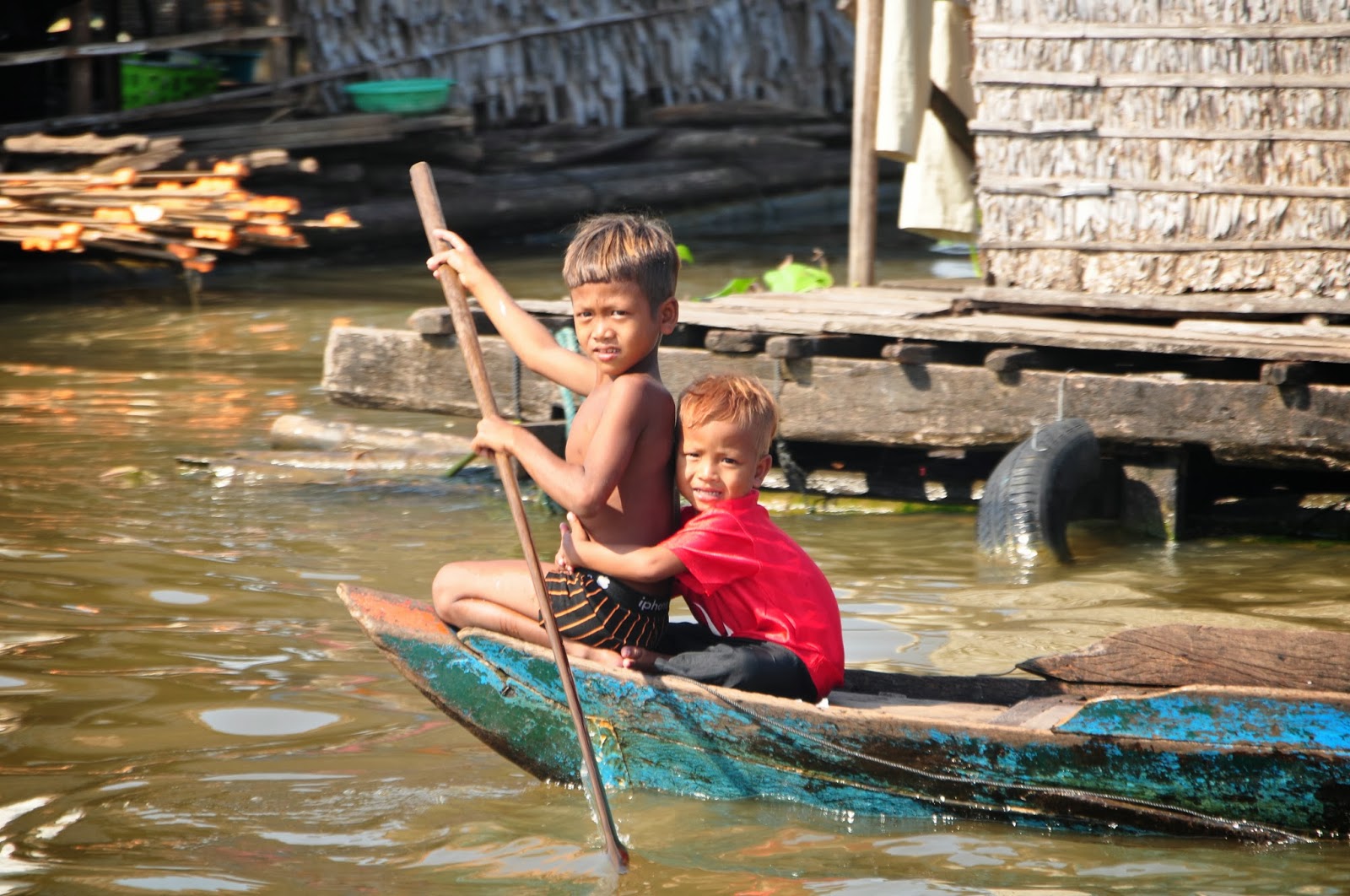
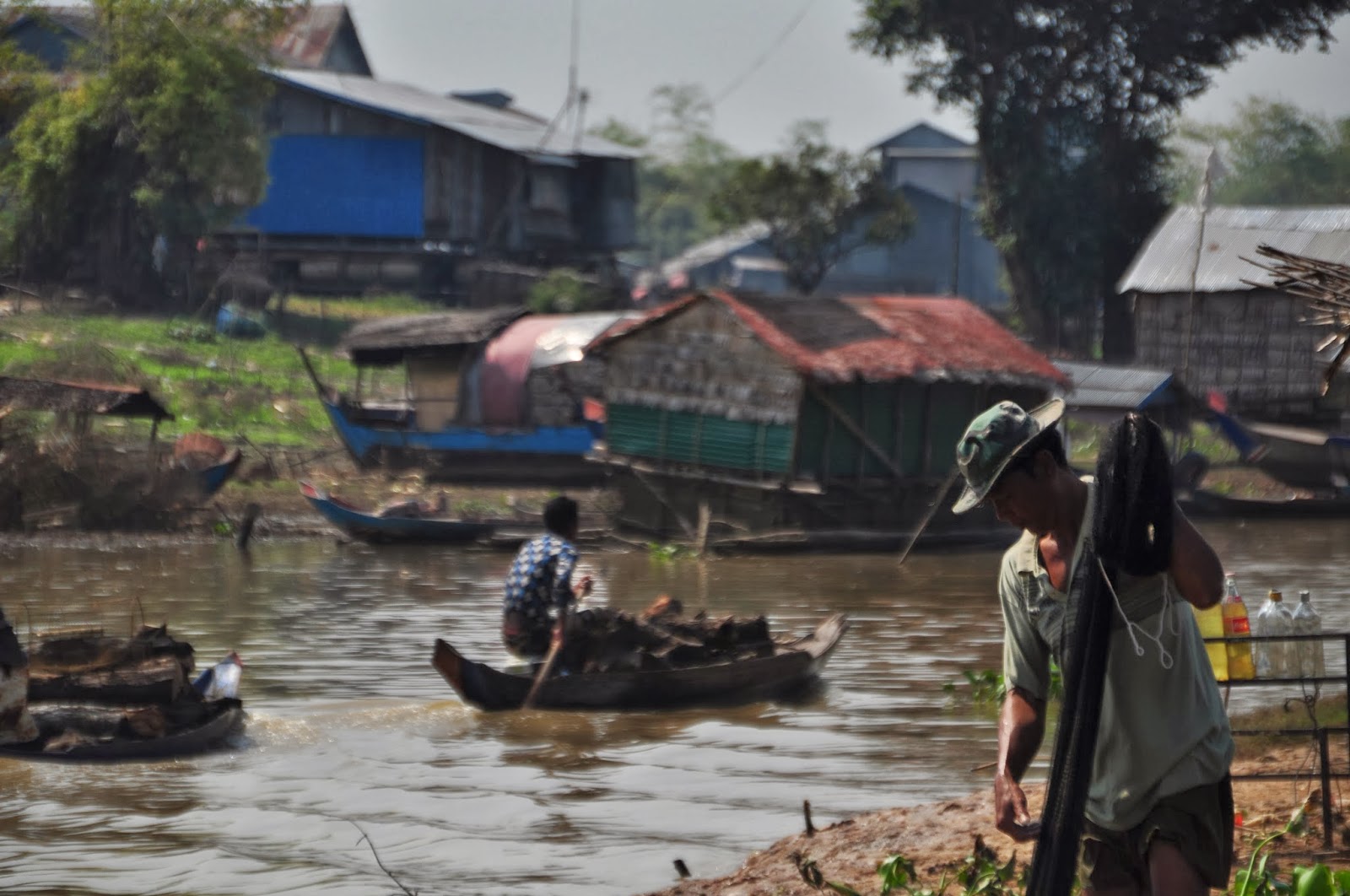
For most of the morning, the trip was absolutely spectacular: we were given a glimpse into the rural lives of Cambodians and watched as they fished, bathed and relied on the river for survival.
I couldn't even count the number of little children waving and yelling 'hello' to us as we floated by.
By midday, we had already passed all the beautiful riverside towns, floating villages and other places of interest; and we had also been sitting on the roof for almost 5 hours in the blazing sun, so we were more than ready to get off!
Eventually, the river widened and we reached Tonle Sap lake, Southeast Asia's largest lake. What better way to enjoy its beautiful flora and fauna than for our boat to break down in the middle of it! Our boat actually broke down twice and took an excessively long time to fix each time.
Once the boat was working again, we finally reached the pier after having been visited by a Cambodian woman selling soft-drinks while jumping from boat to boat with Ninja-like skills.
With dehydration starting to rear its head, we were overwhelmingly pleased to get off that boat. My Ombrelle SPF 60 and Cambodian scarf saved my skin from certain death.
The advertised 7-hour journey ended up taking 10 hours. Despite the heat, the multiple breakdowns and the lack of a proper seat, I don't regret taking that boat: the beauty and cultural wealth of Cambodian life more than made up for it.
As we took a tuk tuk into downtown Siem Reap, the the endless river-ride became a distant memory. The only thing on my mind was temples, temples and more temples!
Subscribe to:
Posts (Atom)