
Oct 3rd-6th
Our receipt said Beijing West. The Chinese Internet train time-table said Beijing West. Even Lonely Planet said Beijing West, but the one source that didn't, and one would think the most important to verify beforehand (which we didn't) was our train ticket, and you guessed it, we ended up going to the wrong train station.
We arrived at Beijing West with 45 minutes to spare before our supposed departure. Upon attempting check-in, the clerk kept on telling us we were not getting in. After getting his supervisor who spoke some English, he informed us that we had gone to the wrong station, but the other station was only 45 minutes away. Unfortunately our train was leaving in 40 minutes.
Our sad departure from Beijing was inadvertently postponed. Lucky us.
We now had to go to the actual train station anyways to try and exchange our ticket, but since it was National Holiday week, getting that initial ticket took far more time than we had hoped and the outlook to get another seemed even more grim.
Someone had told us that during National Holiday, out of China's population of roughly 1.3 billion people, almost 1 billion travel to some extent during that week. So you can just imagine the strain on the transportation system.
Miraculously, we ended up getting 2 sleepers for the following night, but in an upgraded class, necessitating an inflated price. Surprisingly, we only had to pay the difference between the two tickets.
We then found a hostel just across the street from the train station and booked it immediately. I didn't want to miss it a second time.
After a day of killing time and aimless walking, we finally boarded our train to Pingyao in Shanxi province.
Pingyao is considered China's best-preserved ancient walled-city and even has the distinction of being a UNESCO world heritage site. Every guide-book raves about the beauty and level of preservation of this historic city, boasting over 2700 years of history.
We were quite excited.
Our train arrived at around 5am in the darkness of night, with the temperature hovering in the single digits and fog so thick you couldn't see the person in front of you.
Since it was National Holiday, I wasn't able to book a room, but luckily we hopped a ride with two Italian women to one of the hostels I had attempted to book, the lovely Harmony Guest House.
The owner of the hostel told us she did have one room left but it wouldn't be ready until later that day. For the time being, we could just rest on her couch. Nice lady.
As the sun rose and the fog lifted, the ancient charm of Pingyao began to emerge. However, so did the thousands of local tourists who also decided to visit Pingyao on National Holiday week.
The quaint cobblestone streets were so saturated with people that you could barely move let alone enjoy the sights and architecture that Pingyao had to offer.
China is one of the few countries that does not need to rely on foreign tourism to support itself: millions upon millions of Chinese tourists visit all of China's thousands of sites year-round and even more so on National Holiday. It didn't take us long to realize that it would be nearly impossible to enjoy many of China's fascinating dynastic relics or glorious natural reserves without scores of local tourists incessantly hocking up phlegm and spitting, while listening to glass-shattering voices over shitty megaphones explaining every nook and cranny to an uninterested Mandarin tour group.
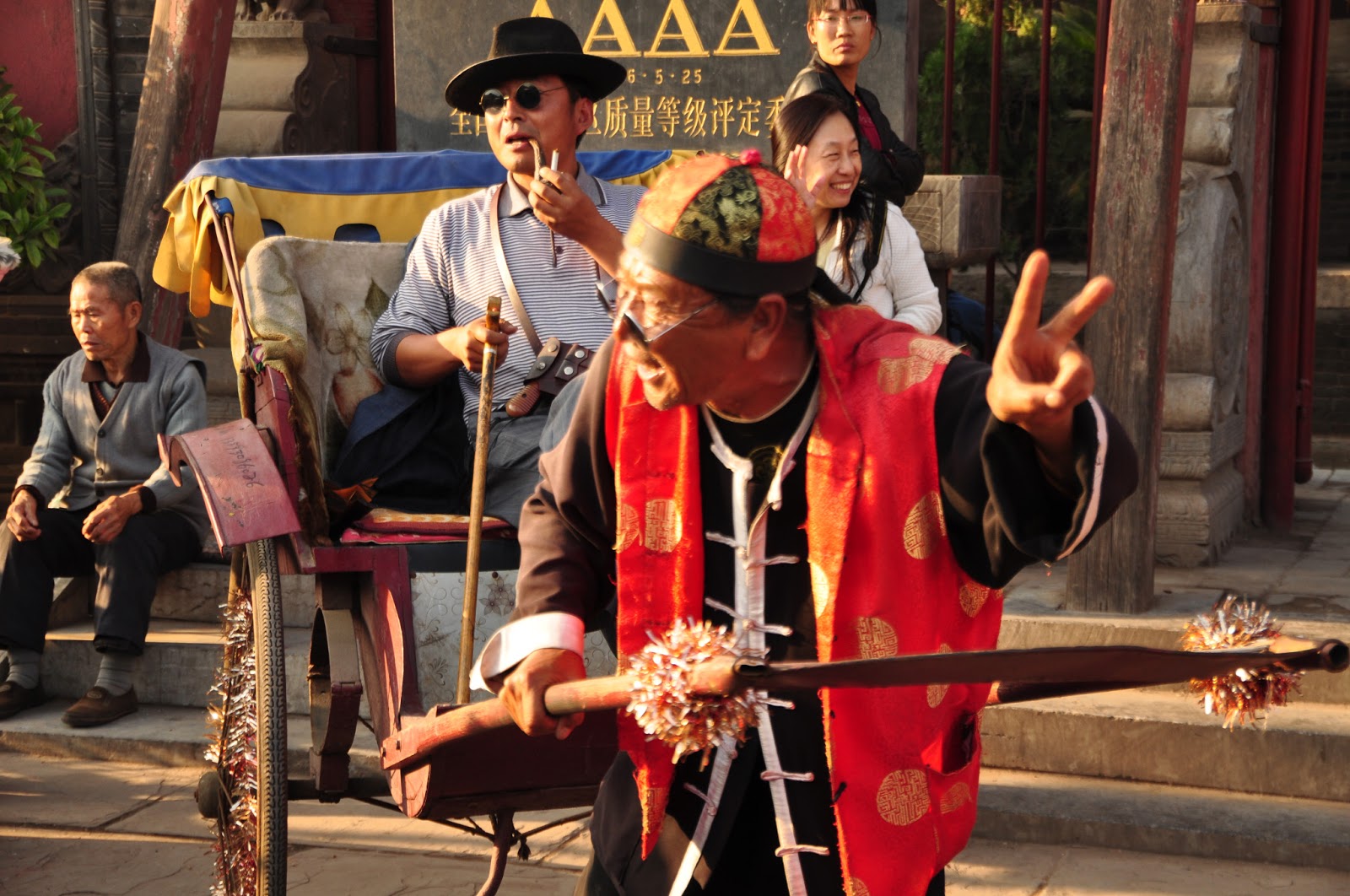
After fighting through the endless crowds and thankfully finding a few less congested areas of the walled city, we decided to ease our stress with some 11:00am beers. As the two of us, both sporting v-neck t-shirts, beards and trendy shades; sipping on beers outside before noon, we quickly attracted the attention of the Chinese tourists. We probably had our picture taken a good 30 times from people either asking our permission directly or pretending to take a picture of the uninteresting bar we were sitting in front of, with their family members awkwardly standing near us as the patriarch urges them to inch ever closer.
Many seemed more excited to get a picture with us than the beautifully preserved city around them. I'm flattered but I don't get it!
Following our calming beers and a little rest, I decided to explore the eastern portion of the city closest to its Daoist temples. To visit anything in Pingyao requires a tourist ticket but it is a joint ticket and visiting anything including climbing the city wall requires you to buy it even if you don't want to visit the accompanying temples.
I didn't feel like visiting the crowded temples which would likely resemble the other temples we had visited, so instead, I climbed up the market tower which provided great views of the city and the sea of people that flowed along its major arteries.
That evening, Josh and I met Daniel, who was teaching English in China and joined him and his mother for a delicious meal of Shanxi cuisine. The highlight of the meal was unbelievable donkey soup accompanied by more donkey meat. That same menu also listed dog as a meal, but we didn't venture down that path.
As we were walking back to our hostel, we noticed Winnie, a Bavarian guy from Munich who had also stayed at Sanlitun hostel, having a drink at his hotel. We stopped in and had a few drinks with him before calling it a night.
The owner of the hostel had booked us a bus to Xi'an the following evening, our next destination. So during the day we wandered around a bit inside the city walls, but took some time to enjoy the tranquility and 72 watch-towers from outside the bustling former financial capital of the Qing dynasty.
To be honest, by Saturday, the second to last day of National Holiday week, the crowds were already much more manageable, at least by Chinese standards.
When we entered our bus, we were surprised to see it was a sleeper bus: essentially a giant mobile bunk-bed accommodating 25-30 people, each having their own bed, but with no upright method to sit.
We drove for around 2 hours of our supposed 6-hour ride before taking our first break. We were scheduled to arrive in Xi'an around midnight, so we were right on track. Around 30 minutes later the bus stopped again. We thought maybe there was a problem with the bus but no one spoke any English to explain what was going on. After waiting 2 hours, the other driver arrived shirtless, out-of-breath and noticeably upset. It appeared as though one of the drivers had left the other driver behind when we had made our first rest-stop and then left him to walk to meet up with us rather than going back to pick him up.
Now that we had both drivers back we could finish our journey. Yeah right. After only another 45 minutes, the bus pulled into a parking lot and turned off its engine. Another break? When I saw the driver put his jacket over his head and used his steering wheel as a pillow, I realized we were not going anywhere for a while. I tried to control my exasperation and rage and tried to get some sleep. The combination of 15 Chinese men snoring evokes the same sound and decibel level of a saw-mill. Combine that with repetitive, incessant shrill Chinese music with a refrain of off-key cymbals banging at irregular intervals, you have a recipe for insomnia.
I still must have fallen asleep at some point because I was awoken by the engine restarting. It was around dawn and we were finally speeding towards Xi'an. Our 6-hour bus ride had turned into a 13-hour exercise in futility and anger-management.
Getting off that bus was pure, unadulterated bliss!
Thursday, January 17, 2013
The Great Wall and Team Sanlitun
Sept 24th-Oct 2nd
Having had our fill of the Chinese palatial experience, losing enthusiasm towards Ming and Qing architecture; and showing indifference towards thousands of Buddhas hiding at every corner, we decided to get out of the city and check out the Great Wall of China.
Jinshanling is located over 100km from Beijing and has no direct public transportation links. In order to get there, we had to take a local bus to Miyun and then hire a private minibus to take us the rest of the way. Despite speaking no Chinese, we were still able to do this rather easily despite being overcharged compared to what the guidebook suggests.
Once there, the feelings of being slighted simply disappeared. We commenced our 10km hike and were continually in awe of this incredible man-made structure and surrounding scenery.
The great wall was started in the Qin dynasty over 2000 years ago. It was during the Ming dynasty that major efforts were made to renovate the then-already crumbling structure. Despite the valiant efforts of the Ming emperors, the Mongols and Manchus were still able to penetrate the world's longest man-made structure.
I've read that no one knows the exact length of the wall, with various estimates ranging from 10,000km to an unfathomable 50,000km! The only thing that is certain is that it is not visible from space.
Jinshanling has also been restored like the popular Badaling portion of the wall, but due to the distance from Beijing and difficulty to get there, it sees far fewer visitors and provides a more intimate wall experience.
The winding grey-brick wall, imposing watch towers and steep green mountain peaks make this a landscape of dreams. We could have done the walk in under 2 hours, but every turn revealed another perspective of this great structure that warranted reflection and countless photos.
What's also great, is that at the end of the Jinshanling portion, you reach the Simatai section of the wall: a more raw, unrestored and steep portion of the wall that is currently closed off to visitors. Josh and I followed the wall past a few watch towers before the wall stopped underneath our feet and we could not go any farther.
More than content with our Jinshanling experience, we decided to visit another section of the wall the following day.
Jiankou, touted as the most beautiful and raw section of the wall, has not been restored like Jinshanling. It is almost completely overgrown with trees and bushes leaving the impression that it has been abandoned and neglected for hundreds of years. To add to its allure, it is even farther and more difficult to visit than the other sections.
As luck would have it, as soon as we started our steep 40-minute ascent towards the wall, it started to rain. By the time we reached the wall itself, it was pouring and the visibility was so poor that we could not see more than a few meters in front of us, let alone the magnificent mountainous scenery supposedly surrounding us.
Jiankou is also reputed as the most dangerous portion of the wall, where collapses have been frequently reported and as a consequence, some sections require full-on vertical climbing. Once you add slippery, loose rocks and torrential rains to the mix, you have the potential for disaster if you aren't careful.
After around an hour-and-a-half of soaked climbing, slippery rocks and zero visibility, we decided to head back, still content with our unique experience and knowledge that we were completely alone on the wall that day, no one else being that ambitious or perhaps stupid to continue the ascent.
With a euphoric sense of accomplishment, the day did not end without casualties, that being Josh's passport, which he mistakenly left in an exposed area of his backpack, rendering it completely soaked and potentially ruined.
We visited the Canadian embassy the following day to assess the damage. The agent stated that technically he was supposed to confiscate it because it was in fact ruined, but it was still scannable and his Chinese visa was miraculously still intact. Rather than wait nearly a month to get a new passport and reapply for another Chinese visa, we decided to take our chances with this damaged document. That same night marked the return of Kim from Xi'an and we got to enjoy one final evening in his company.
The following day we said goodbye to our wonderful host and left the Haidian district because we had booked several nights at the Sanlitun Youth Hostel, located not too far from the Canadian embassy.
Sanlitun is an upscale expat area resulting from its proximity to all the foreign embassies, and is also a gateway to many of Beijing's best bars and nightlife. As soon as we arrived, we instantly made friends with the other guests and before long had amassed quite the crew.
After settling in to our hostel on the first day, we decided to go to the Chinese National Museum: an immense building housing both domestic and international works of art, ancient artifacts and paintings.
We devoted our time between the story of post-dynastic China (aka the communist propaganda exhibit of The Road to Rejuvenation) and Ancient China, proving that the dynastic Chinese must have been wasted 24-7 because every second artifact was a spectacularly decorated wine vessel.
On our way back, some Chinese guy stepped on my foot and broke my flip-flop beyond repair, making the rest of my journey through the metro and 15-minute walk back to the hostel one-footed. At least Beijing's transit system and roads are far cleaner than Montreal's!
That evening, some of the staff taught us how to make dumplings and while Josh and the others showed some degree of culinary skills and artistic abilities, mine ended up looking more like dump than dumplings. From this point on we enjoyed beers with our new friends and had international fooseball tournaments.
Prior to this, Josh and I decided that we were not completely content with our Jiankou experience and that we would return when the weather was better. We decided to go on the Sunday and to tell only a few people about it since big groups generally lead to more complications.
However, after having drank too much beer, Josh and I had invited nearly everyone staying at the hostel except two Swedish girls, Camilla and Fredrika, who Josh had jokingly uninvited after we realized that our intended small group had ballooned to a veritable tour group. People I didn't even recognize were asking me if the event was still on!
On Sunday morning, 14 people, ourselves included, were headed for Jiankou!
Josh and I were joined by Laurel, Sinead, Randi, Joey, Ilya and Avi, who were all teachers from western Canada teaching in Weifang. Aside from team Canada, we had two Swedish guys, Joey from Texas, Magdalene from Singapore and her chinese-only speaking friend and Helinä from Finland to finish up our stellar group.
Despite some minor setbacks like bargaining with a guy to get a private bus to and from the wall for 20 minutes only to have the driver refuse at the last minute, and Ilya and Joey getting on a different bus, we all still managed to make it to the wall by noon.
Josh and I were elated to return to Jiankou with clear skies and dry weather, because the scenery was truly stunning. Even though our numbers dwindled the steeper and more dangerous the climb became, ten of us still managed to reach the loop leading back to our hired cars. An old man wanted to charge us to use a ladder to descend to the path but we thought he was just being opportunistic. Rather than pay his 50-cent toll, we instead climbed down an adjacent portion, risking our ankles as we landed on a slope to avoid his meager fee (it was the principle!)
However, the man saw us doing this and as soon as we started to leave his sight, he started to blow a whistle. At this point we didn't know if this was in fact his land and he was signaling to his gun or pitch-fork-weilding family members to get the trespassers (aka us). Needless to say we hurried up so we wouldn't have to find out!
It was an altogether fantastic day and it made Josh and I feel really great because everyone kept on thanking us for organizing the whole thing. Sometimes alcohol-related mistakes do lead to a happy ending!
After a terrific meal, we all returned to Sanlitun for some celebratory partying.
The next day everyone was parting ways and Team Sanlitun would be no more.
How sad.
Josh and I would be moving to Dreams Hostel in the Chinese hipster-district of Golou Dongdajie because Sanlitun was booked due to the National Holiday.
We spent our last few days in Beijing wandering around this trendy district and revisiting Beijing's beautiful back lakes.
On our final evening, we met up with Helinä, Joey, Fredrika and Camilla to watch the unfortunately smoggy sun-set at Jinghan park before having a proper send-off with drinking games and shisha.
Beijing delivered more than Josh and I could ever imagine, with its countless sights of imperial splendor, tranquil lake areas and diverse neighborhoods.
Also, with so many amazing people we met at our hostel and through couchsurfing, Beijing would be hard to beat.
We were quite sad to leave, but we wouldn't be leaving as soon as we had planned...
Having had our fill of the Chinese palatial experience, losing enthusiasm towards Ming and Qing architecture; and showing indifference towards thousands of Buddhas hiding at every corner, we decided to get out of the city and check out the Great Wall of China.
Jinshanling is located over 100km from Beijing and has no direct public transportation links. In order to get there, we had to take a local bus to Miyun and then hire a private minibus to take us the rest of the way. Despite speaking no Chinese, we were still able to do this rather easily despite being overcharged compared to what the guidebook suggests.
Once there, the feelings of being slighted simply disappeared. We commenced our 10km hike and were continually in awe of this incredible man-made structure and surrounding scenery.
The great wall was started in the Qin dynasty over 2000 years ago. It was during the Ming dynasty that major efforts were made to renovate the then-already crumbling structure. Despite the valiant efforts of the Ming emperors, the Mongols and Manchus were still able to penetrate the world's longest man-made structure.
I've read that no one knows the exact length of the wall, with various estimates ranging from 10,000km to an unfathomable 50,000km! The only thing that is certain is that it is not visible from space.
Jinshanling has also been restored like the popular Badaling portion of the wall, but due to the distance from Beijing and difficulty to get there, it sees far fewer visitors and provides a more intimate wall experience.
The winding grey-brick wall, imposing watch towers and steep green mountain peaks make this a landscape of dreams. We could have done the walk in under 2 hours, but every turn revealed another perspective of this great structure that warranted reflection and countless photos.
What's also great, is that at the end of the Jinshanling portion, you reach the Simatai section of the wall: a more raw, unrestored and steep portion of the wall that is currently closed off to visitors. Josh and I followed the wall past a few watch towers before the wall stopped underneath our feet and we could not go any farther.
More than content with our Jinshanling experience, we decided to visit another section of the wall the following day.
Jiankou, touted as the most beautiful and raw section of the wall, has not been restored like Jinshanling. It is almost completely overgrown with trees and bushes leaving the impression that it has been abandoned and neglected for hundreds of years. To add to its allure, it is even farther and more difficult to visit than the other sections.
As luck would have it, as soon as we started our steep 40-minute ascent towards the wall, it started to rain. By the time we reached the wall itself, it was pouring and the visibility was so poor that we could not see more than a few meters in front of us, let alone the magnificent mountainous scenery supposedly surrounding us.
Jiankou is also reputed as the most dangerous portion of the wall, where collapses have been frequently reported and as a consequence, some sections require full-on vertical climbing. Once you add slippery, loose rocks and torrential rains to the mix, you have the potential for disaster if you aren't careful.
After around an hour-and-a-half of soaked climbing, slippery rocks and zero visibility, we decided to head back, still content with our unique experience and knowledge that we were completely alone on the wall that day, no one else being that ambitious or perhaps stupid to continue the ascent.
With a euphoric sense of accomplishment, the day did not end without casualties, that being Josh's passport, which he mistakenly left in an exposed area of his backpack, rendering it completely soaked and potentially ruined.
We visited the Canadian embassy the following day to assess the damage. The agent stated that technically he was supposed to confiscate it because it was in fact ruined, but it was still scannable and his Chinese visa was miraculously still intact. Rather than wait nearly a month to get a new passport and reapply for another Chinese visa, we decided to take our chances with this damaged document. That same night marked the return of Kim from Xi'an and we got to enjoy one final evening in his company.
The following day we said goodbye to our wonderful host and left the Haidian district because we had booked several nights at the Sanlitun Youth Hostel, located not too far from the Canadian embassy.
Sanlitun is an upscale expat area resulting from its proximity to all the foreign embassies, and is also a gateway to many of Beijing's best bars and nightlife. As soon as we arrived, we instantly made friends with the other guests and before long had amassed quite the crew.
After settling in to our hostel on the first day, we decided to go to the Chinese National Museum: an immense building housing both domestic and international works of art, ancient artifacts and paintings.
We devoted our time between the story of post-dynastic China (aka the communist propaganda exhibit of The Road to Rejuvenation) and Ancient China, proving that the dynastic Chinese must have been wasted 24-7 because every second artifact was a spectacularly decorated wine vessel.
On our way back, some Chinese guy stepped on my foot and broke my flip-flop beyond repair, making the rest of my journey through the metro and 15-minute walk back to the hostel one-footed. At least Beijing's transit system and roads are far cleaner than Montreal's!
That evening, some of the staff taught us how to make dumplings and while Josh and the others showed some degree of culinary skills and artistic abilities, mine ended up looking more like dump than dumplings. From this point on we enjoyed beers with our new friends and had international fooseball tournaments.
Prior to this, Josh and I decided that we were not completely content with our Jiankou experience and that we would return when the weather was better. We decided to go on the Sunday and to tell only a few people about it since big groups generally lead to more complications.
However, after having drank too much beer, Josh and I had invited nearly everyone staying at the hostel except two Swedish girls, Camilla and Fredrika, who Josh had jokingly uninvited after we realized that our intended small group had ballooned to a veritable tour group. People I didn't even recognize were asking me if the event was still on!
On Sunday morning, 14 people, ourselves included, were headed for Jiankou!
Josh and I were joined by Laurel, Sinead, Randi, Joey, Ilya and Avi, who were all teachers from western Canada teaching in Weifang. Aside from team Canada, we had two Swedish guys, Joey from Texas, Magdalene from Singapore and her chinese-only speaking friend and Helinä from Finland to finish up our stellar group.
Despite some minor setbacks like bargaining with a guy to get a private bus to and from the wall for 20 minutes only to have the driver refuse at the last minute, and Ilya and Joey getting on a different bus, we all still managed to make it to the wall by noon.
Josh and I were elated to return to Jiankou with clear skies and dry weather, because the scenery was truly stunning. Even though our numbers dwindled the steeper and more dangerous the climb became, ten of us still managed to reach the loop leading back to our hired cars. An old man wanted to charge us to use a ladder to descend to the path but we thought he was just being opportunistic. Rather than pay his 50-cent toll, we instead climbed down an adjacent portion, risking our ankles as we landed on a slope to avoid his meager fee (it was the principle!)
However, the man saw us doing this and as soon as we started to leave his sight, he started to blow a whistle. At this point we didn't know if this was in fact his land and he was signaling to his gun or pitch-fork-weilding family members to get the trespassers (aka us). Needless to say we hurried up so we wouldn't have to find out!
It was an altogether fantastic day and it made Josh and I feel really great because everyone kept on thanking us for organizing the whole thing. Sometimes alcohol-related mistakes do lead to a happy ending!
After a terrific meal, we all returned to Sanlitun for some celebratory partying.
The next day everyone was parting ways and Team Sanlitun would be no more.
How sad.
Josh and I would be moving to Dreams Hostel in the Chinese hipster-district of Golou Dongdajie because Sanlitun was booked due to the National Holiday.
We spent our last few days in Beijing wandering around this trendy district and revisiting Beijing's beautiful back lakes.
On our final evening, we met up with Helinä, Joey, Fredrika and Camilla to watch the unfortunately smoggy sun-set at Jinghan park before having a proper send-off with drinking games and shisha.
Beijing delivered more than Josh and I could ever imagine, with its countless sights of imperial splendor, tranquil lake areas and diverse neighborhoods.
Also, with so many amazing people we met at our hostel and through couchsurfing, Beijing would be hard to beat.
We were quite sad to leave, but we wouldn't be leaving as soon as we had planned...
Sunday, December 9, 2012
Welcome to the Beijing Zoo
Sept 20th-23rd
Our 24-hour train ride from Hong Kong went incredibly quickly and as soon as we stepped off the train, we knew we were in a different world.
We luckily weren't completely in the dark because I had arranged to stay with a German couchsurfer and he had given us incredibly detailed directions to his place.
We hopped on a bus and managed to get off at the suggested stop with the help of the Chinese characters Kim included. After going the wrong way a few times and asking a few people for directions, we finally found Kim's flat.
He instantly welcomed us, showed us how to use his amenities and we were off to the races! Kim had to meet someone for dinner but still had enough time to show us a local market and suggest some nearby restaurants for dinner.
After our first of many Peking Duck and pork-stuffed eggplant dinners, we waited for Kim to get back from his friend's. For the rest of the evening, we discussed our respective professions and back stories; our travels and goals for China and beyond; and he attempted to teach us some words in mandarin. Good luck, mandarin is ridiculously difficult.
Kim lived in Haidian, the university district between Renmin and Peking University, working at the latter as a researcher in linguistics and their application in computer programs or something along those lines.
On our first full day in Beijing, we decided to visit Beijing's most famed monument: the Forbidden City. The Forbidden city's name stems from the fact it was off limits for 500 years and it acted as the residence of China's two final dynasties: the Ming and Qing dynasty.
We entered the city via the Gate of Heavenly Peace, with the iconic portrait of Chairman Mao on its facade. We then passed through the immense courtyard to reach the museum entrance (the city itself).
We spent several hours walking through the immense grounds, astonishingly long corridors; and sauntering to the innumerable halls, temples and palaces contained within this sprawling complex.
Every aspect of this complex was immaculate and ornate, it is no wonder these emperors were seen as gods.
Despite the grandeur of the site, the wonderful halls of Supreme Harmony and Middle Harmony; and the impressive nine Dragon Screen; a little is lost by the sheer amount of people who descend on this site at any given time. A little more forbiddeness would be nice!
I wouldn't be surprised if the Forbidden City saw hundreds of thousands of tourists per day, most of which are local tourists in their immense tour groups led by shrill-voiced, mandarin-speaking, flag-baring guides.
Approaching any of the relics contained within these wonderful halls is like trying to take pictures of the world's biggest celebrities: hundreds of cameras flashing, people pushing their way to the front with a complete disregard for others waiting in an orderly fashion.
Complete chaos!
Once we had seen the main central halls, we made our way to the eastern and western portions of the city to get away from the central areas of interest and consequently calamitous site-seeing conditions.
Upon leaving the Forbidden City, we crossed the street to Jingshan park, a park whose grounds were formed by the earth excavated to create the moat around the forbidden city. From the top of the hill you get fantastic views of the Forbidden City, although Beijing's notorious smog obstructed the clarity of our view.
We then walked around the outer wall, which brought us back to Tian'an men Square, said to be the world's largest square (90 football fields) and the infamous standoff point between the man and the government tanks during the student prodemocracy protests of 1989.
Tian'an men Square is flanked by the Forbidden City to the north, the Great Hall of the People to the west, and the Chinese National museum to the east. The square also contains the mausoleum of Mao Zedong and the granite obelisk known as the Monument to the People's Heroes.
The square was being cleaned up and decorated for the upcoming National Day on October first, being China's version of Canada Day, where seemingly the equivalent of Canada's population will descend on the square for the day's festivities.
Completely spent from our day's activities, we headed back to Kim's. Always a man on the move, Kim joined us for a quick dinner but had to leave to the train station to visit his girlfriend who lives in Xi'an. He would be gone until the middle of the following week and had graciously offered to let us stay in his apartment during his absence. We were extremely grateful and elated by his offer.
The next day we decided to do a walk suggested by Frommer's guide to China, exploring Beijing's Back Lakes.
Our walk started at Mei Lanfang Guju, home of Peking Opera star Mei Lanfang and a beautiful example of Beijing's famed siheyuan (courtyard home) and hutong (narrow and winding alley) neighborhoods that define the old city. From there we passed the former campus of Furen University and visited Prince Gong's mansion.
Built in 1777, this lavish courtyard residence was the former home of its namesake, boasting numerous pavilions, temples and even a coy pond with ducks. Luckily we had arrived early enough to avoid the influx of Chinese tourists entering.
Our next stop was wild duck island built on the beautiful Hou Hai lake. We then continued around the lake admiring the scenery and the happy young couples on tandem bicycles and paddle-boats; as well as the elderly being escorted by rickshaws.
Simply wonderful!
Our walk terminated at the impressive Drum and Bell towers providing beautiful albeit smoggy views of the surrounding hutong neibouhoods.
Being suckers for punishment, we walked up the Chinese hipster street of Gulou Dongdajie and continued on for another 45-minutes before reaching the mystical Lama Temple.
The Lama Temple is the most renown Tibetan temple outside of Tibet. The grounds were swarming with white tourists seeing as though we're all infatuated with Tibet, their struggle for freedom and self-immolations.
Although the outer architecture resembles many other Ming and Qing dynasty buildings, many elements were purely Tibetan, from their ornate and detailed Buddhist statues to Tibetan cursive banners and relics adorning the various buildings.
What was particularly interesting is that it is still an active place of worship, with scores of Buddhists burning incense for various deities. I'll find it in my heart to forgive the goofy white guy trying to emulate the actual Buddhists praying beside him, but common, show some respect!
The most impressive and surprising relic contained within this complex was the 18m statue of Buddha in the unassuming Wanfu pavilion.
Our final stop of the day was to the Temple of Heaven Park. A leisurely walk through the grounds led us to the park's dominant feature, passing competing choirs of elderly Chinese and people of all ages engaging in some sort of activity.
The Hall of Prayer for Good Harvests is the iconic building associated with the Temple of Heaven and it was a nice change from the boxy architecture of most Ming and Qing buildings around Beijing.
That night we attempted to get the same great meal of Peking duck and pork-infused eggplant but a failure to communicate properly left us duck-less.
Our tourism marathon continued on the next day with the immaculate Summer Palace. This palace acted as the Imperial Court's summer getaway and both Josh and I found it more impressive than the Forbidden. City. We spent most of the day admiring the palace's unique architecture, circling Kunming Lake and hiking up countless stairs to reach the Buddhist Temple of the Sea of Wisdom and the Buddhist Fragrance pavilion.
What I really loved about this place was that it was large enough to escape the throngs of tourists and have a little tranquility within this unrelenting capital city.
Our final stop of the day was to Beijing's Bird Nest or National Stadium, used for the 2008 Summer Olympics. We had arrived too late to enter this beautiful feat of modern architecture, but the view from the outside was still worth it. I couldn't help but wonder what this city looked like prior to the Olympics: China apparently invested 40 billion (yes you read that right) dollars to hold the games and renovate the city.
After just three days, we had seen some incredible sites and visited some awe-inspiring structures, but still the greatest of all man-made structures, arguably in the entire world, sprawled just beyond Beijing. The next few days would distance us from the Beijing zoo and bring us to the immeasurable Great Wall of China!
Our 24-hour train ride from Hong Kong went incredibly quickly and as soon as we stepped off the train, we knew we were in a different world.
We luckily weren't completely in the dark because I had arranged to stay with a German couchsurfer and he had given us incredibly detailed directions to his place.
We hopped on a bus and managed to get off at the suggested stop with the help of the Chinese characters Kim included. After going the wrong way a few times and asking a few people for directions, we finally found Kim's flat.
He instantly welcomed us, showed us how to use his amenities and we were off to the races! Kim had to meet someone for dinner but still had enough time to show us a local market and suggest some nearby restaurants for dinner.
After our first of many Peking Duck and pork-stuffed eggplant dinners, we waited for Kim to get back from his friend's. For the rest of the evening, we discussed our respective professions and back stories; our travels and goals for China and beyond; and he attempted to teach us some words in mandarin. Good luck, mandarin is ridiculously difficult.
Kim lived in Haidian, the university district between Renmin and Peking University, working at the latter as a researcher in linguistics and their application in computer programs or something along those lines.
On our first full day in Beijing, we decided to visit Beijing's most famed monument: the Forbidden City. The Forbidden city's name stems from the fact it was off limits for 500 years and it acted as the residence of China's two final dynasties: the Ming and Qing dynasty.
We entered the city via the Gate of Heavenly Peace, with the iconic portrait of Chairman Mao on its facade. We then passed through the immense courtyard to reach the museum entrance (the city itself).
We spent several hours walking through the immense grounds, astonishingly long corridors; and sauntering to the innumerable halls, temples and palaces contained within this sprawling complex.
Every aspect of this complex was immaculate and ornate, it is no wonder these emperors were seen as gods.
Despite the grandeur of the site, the wonderful halls of Supreme Harmony and Middle Harmony; and the impressive nine Dragon Screen; a little is lost by the sheer amount of people who descend on this site at any given time. A little more forbiddeness would be nice!
I wouldn't be surprised if the Forbidden City saw hundreds of thousands of tourists per day, most of which are local tourists in their immense tour groups led by shrill-voiced, mandarin-speaking, flag-baring guides.
Approaching any of the relics contained within these wonderful halls is like trying to take pictures of the world's biggest celebrities: hundreds of cameras flashing, people pushing their way to the front with a complete disregard for others waiting in an orderly fashion.
Complete chaos!
Once we had seen the main central halls, we made our way to the eastern and western portions of the city to get away from the central areas of interest and consequently calamitous site-seeing conditions.
Upon leaving the Forbidden City, we crossed the street to Jingshan park, a park whose grounds were formed by the earth excavated to create the moat around the forbidden city. From the top of the hill you get fantastic views of the Forbidden City, although Beijing's notorious smog obstructed the clarity of our view.
We then walked around the outer wall, which brought us back to Tian'an men Square, said to be the world's largest square (90 football fields) and the infamous standoff point between the man and the government tanks during the student prodemocracy protests of 1989.
Tian'an men Square is flanked by the Forbidden City to the north, the Great Hall of the People to the west, and the Chinese National museum to the east. The square also contains the mausoleum of Mao Zedong and the granite obelisk known as the Monument to the People's Heroes.
The square was being cleaned up and decorated for the upcoming National Day on October first, being China's version of Canada Day, where seemingly the equivalent of Canada's population will descend on the square for the day's festivities.
Completely spent from our day's activities, we headed back to Kim's. Always a man on the move, Kim joined us for a quick dinner but had to leave to the train station to visit his girlfriend who lives in Xi'an. He would be gone until the middle of the following week and had graciously offered to let us stay in his apartment during his absence. We were extremely grateful and elated by his offer.
The next day we decided to do a walk suggested by Frommer's guide to China, exploring Beijing's Back Lakes.
Our walk started at Mei Lanfang Guju, home of Peking Opera star Mei Lanfang and a beautiful example of Beijing's famed siheyuan (courtyard home) and hutong (narrow and winding alley) neighborhoods that define the old city. From there we passed the former campus of Furen University and visited Prince Gong's mansion.
Built in 1777, this lavish courtyard residence was the former home of its namesake, boasting numerous pavilions, temples and even a coy pond with ducks. Luckily we had arrived early enough to avoid the influx of Chinese tourists entering.
Our next stop was wild duck island built on the beautiful Hou Hai lake. We then continued around the lake admiring the scenery and the happy young couples on tandem bicycles and paddle-boats; as well as the elderly being escorted by rickshaws.
Simply wonderful!
Our walk terminated at the impressive Drum and Bell towers providing beautiful albeit smoggy views of the surrounding hutong neibouhoods.
Being suckers for punishment, we walked up the Chinese hipster street of Gulou Dongdajie and continued on for another 45-minutes before reaching the mystical Lama Temple.
The Lama Temple is the most renown Tibetan temple outside of Tibet. The grounds were swarming with white tourists seeing as though we're all infatuated with Tibet, their struggle for freedom and self-immolations.
Although the outer architecture resembles many other Ming and Qing dynasty buildings, many elements were purely Tibetan, from their ornate and detailed Buddhist statues to Tibetan cursive banners and relics adorning the various buildings.
What was particularly interesting is that it is still an active place of worship, with scores of Buddhists burning incense for various deities. I'll find it in my heart to forgive the goofy white guy trying to emulate the actual Buddhists praying beside him, but common, show some respect!
The most impressive and surprising relic contained within this complex was the 18m statue of Buddha in the unassuming Wanfu pavilion.
Our final stop of the day was to the Temple of Heaven Park. A leisurely walk through the grounds led us to the park's dominant feature, passing competing choirs of elderly Chinese and people of all ages engaging in some sort of activity.
The Hall of Prayer for Good Harvests is the iconic building associated with the Temple of Heaven and it was a nice change from the boxy architecture of most Ming and Qing buildings around Beijing.
That night we attempted to get the same great meal of Peking duck and pork-infused eggplant but a failure to communicate properly left us duck-less.
Our tourism marathon continued on the next day with the immaculate Summer Palace. This palace acted as the Imperial Court's summer getaway and both Josh and I found it more impressive than the Forbidden. City. We spent most of the day admiring the palace's unique architecture, circling Kunming Lake and hiking up countless stairs to reach the Buddhist Temple of the Sea of Wisdom and the Buddhist Fragrance pavilion.
What I really loved about this place was that it was large enough to escape the throngs of tourists and have a little tranquility within this unrelenting capital city.
Our final stop of the day was to Beijing's Bird Nest or National Stadium, used for the 2008 Summer Olympics. We had arrived too late to enter this beautiful feat of modern architecture, but the view from the outside was still worth it. I couldn't help but wonder what this city looked like prior to the Olympics: China apparently invested 40 billion (yes you read that right) dollars to hold the games and renovate the city.
After just three days, we had seen some incredible sites and visited some awe-inspiring structures, but still the greatest of all man-made structures, arguably in the entire world, sprawled just beyond Beijing. The next few days would distance us from the Beijing zoo and bring us to the immeasurable Great Wall of China!
Labels:
Asia,
Back Lakes,
Beijing,
Bird Nest,
China,
Forbidden City,
Gate of Heavenly Peace,
Haidian,
Hutong,
Lama Temple,
National Day,
Peking Duck,
Summer Palace,
Temple of Heaven,
Tian'an men Square
Subscribe to:
Posts (Atom)