Showing posts with label Jordan. Show all posts

Tuesday, September 4, 2012

Madaba and Amman Part II: Welcome to Jordan!

Aug 17-22

Our return from the Dead Sea coincided with the return of Gus and his father, also Gus, from the south of Jordan. They were heading to Jerash in northern Jordan and asked Josh, Chris and I if we wanted to tag along. We eagerly agreed.


Jerash is the modern name of the Roman city Gerasa. The city stems from the time of Alexander the Great and reached its peak in the 3rd century A.D.


We spent a few hours wandering past impressive ruins like Hadrian's Arch and the hippodrome, which is still used for mock chariot races and gladiator fights, but unfortunately postponed until the end of Ramadan.


Ramadammit!


From there we piled into the Guses' rental car and tried to get into Bethany, the baptismal site of Jesus, but it too was closed early due to Ramadan. Go figure!


Feeling slightly rejected, we went to the Dead Sea again and watched the Guses enjoy the salty marvel.

The following day we went to Wadi Mujib, sometimes referred to as the Grand Canyon of Jordan. This valley is 1km deep and is part of the Wadi Mujib nature reserve.


The trail is much like that of Zarqa Ma'in, but is more beautiful and the water is cooler and therefore far more refreshing. Another fun difference is that ropes are set up at various points along the route to aid climbing up small waterfalls along the way. This short trek, taking only one hour each way, terminates at a beautiful and powerful waterfall.


For some reason, we seemed to have arrived in Madaba during the escalation of a feud between two powerful Muslim families, the Halmidas and the Alzaidas (no idea on the spelling of either of them). It all started when 2 members of the Halmida family took a member of the Alzaida family to the Wadi Zarqa Ma'in and killed him in cold blood. The victim's family is pushing for the death penalty (which doesn't exist in Jordan) for the perpetrators, but the trial is only slated to start in the fall, increasing the animosity between the two families.

Gus jr. told us there were riot police and tear gas being used at semi-regular intervals to break up the common skirmishes in the streets.

One night as the Guses, Chris and myself were enjoying some drinks at Haret Jdoudna, we noticed the staff continually looking out the front door. We were there until closing and the staff advised us to leave out the back door despite our hotel being just across the street.

As we exited, we saw flashing police lights and heard a commotion coming from the street over As we approached our hotel, we saw groups of young men running down the street towards us. There were riot police in full gear hitting stragglers with their batons and kicking doors. We were the only people moving towards the police. Gus jr. was telling the police that he lived here (we were next to St. Georges church) and when Chris asked the officer if we could just go back to our hotel, the officer gave a resounding No!, but followed it up with a comically misplaced "Welcome to Jordan!".

We ended up waiting at Gus' place before being escorted back to our hotel by a member of Jordan's equivalent of the FBI.

Crazy night!

Nearly every few minutes in Jordan, someone will stop and ask you "where you from?", and will immediately follow it up with "you are welcome". If people know only three words in the English language , they'll be "Welcome to Jordan". Despite the tense situation from the night before, Chris and I couldn't help but laugh when the officer welcomed us to Jordan after beating some rival clans and chasing people in the streets.

You can't make this stuff up!

After nearly a week in Madaba, we packed our bags and headed to Amman, Jordan's capital. While not much to look at aesthetically speaking, the city's mountainous landscape and lack of rival family clashes made it a welcomed change.

Our first day was spent walking along Amman's famed Rainbow street, followed by a viewing of the Dark Knight Rises.

Our arrival in Amman coincided with the second day of Eid al-Fitr or the festival celebrating the end of Ramadan, so people were in a more festive (i.e. drinky) mood. We celebrated Eid in the apparently typical Ammanian way: by getting drunk at bars that also double as bookstores during the day! There's nothing like losing brain cells while being surrounded by intellectual reading material!

During the night, Chris and I got in a little grappling match and he tripped backwards (I didn't push him I swear!) and hit his head on the street, knocking himself unconscious for a few seconds. Gus and I made sure he was okay and then we went for shisha.

The next day we nursed our hangovers and Chris the bump on the back of his head, not really doing much during the day. I decided to visit Amman's Roman amphitheater, one of the few remnants of the ancient city known as Philadelphia. The theatre can hold 6000 people and is still used for live events to this day.


From the theatre you can see the citadel, which sits on Amman's highest hill and comprises various ruins including the Temple of Hercules.


From there I visited the nymphaeum, or Roman fountain, and took a quick peak at the King Hussein Mosque before returning to our hotel.


That evening, we were invited by some Jordanian girls who spoke to us the night before and somehow didn't realize how drunk we were, for some coffee and shisha (narghile in Jordan). We were later joined by some other people from Dubai, Palestine, Ukraine and various other places. We had a great time discussing, joking around and learning about each others' culture and backgrounds.

It was unfortunate that we met all these great people right before leaving for our next destination, but alas, such is life on the road!

Thursday, August 30, 2012

Madaba Part I: Mosaics of Biblical Proportions

Aug 13-16

After an hour cab ride to Aqaba, a 5-hour bus ride to Amman and then two more cab rides, we finally arrived in the city of Madaba.

Madaba is located 30km southwest of Amman, but provides a laid-back alternative to the bustling capital. It is also the Christian capital of Jordan, with around one third of its inhabitants calling Jesus their saviour. The sparse city-center skyline is dominated by the bell tower of the catholic church and the two minarets of the central mosque.


Historically, these two faiths have lived peacefully side-by-side for centuries, being a model example of religious coexistence and tolerance in the Middle East, which is not a statement often heard.


We managed to get one of the few rooms available in the city. The following nights, however, we had booked at the wonderful Queen Ayola hotel.

On our first full day in Madaba, one of Queen Ayola's owners, Fadi, gave us a tour of Madaba's Catholic church, with its Byzantine-era ruins as well as the Madaba museum.


Madaba is known for its Byzantine mosaics. They can be found nearly everywhere and continue to be unearthed during excavations and even regular construction projects.


The most famous mosaic is that of St. Georges church. Although the church only dates from 1884, the mosaic was discovered during construction and subsequently incorporated into the designs. The mosaic was crafted in 560A.D. and represents the earliest known map of the Holy Land (comprising most of the sites and cities mentioned in the Bible).


Since we were quickly mosaiced-out, we decided to leave Madaba for the day and head towards the Dead Sea. Our first stop was Mount Nebo, where Moses supposedly was shown the promised land and where he was apparently buried.


From there, our driver stopped along the Dead Sea highway and we descended along a rocky path to the banks of the Dead Sea. From out of nowhere, our driver pulls out a bag full of special Dead Sea mud and we inadvertently and unfortunately ended up looking like blackface from the turn of the century.


After drying our mud in the sun, we went for a dip in the fabled salty lake. Lying at under 400m below sea-level, the Dead Sea is the lowest place on earth. Due to the intense heat and non-existent precipitation in the area, the water remains at a salinity of around 30% due to evaporation.


Swimming in it is a truly bizarre experience, feeling like you're in suspended animation rather than sea water. We spent a good while trying ridiculous positions and seemingly impossible configurations.


Our next stop was Wadi Zarqa Ma'in, a 2-hour trek upstream through the Hammamet Ma'in hot-spring-fed river: imagine hiking up a jacuzzi river in 45 degree heat. Great, but dehydrating to say the least!

Our day culminated with a beautiful panorama view of the Dead Sea and surrounding valley. Now I'm not a religious person, but this area could definitely inspire many people to believe in something greater than themselves.


Holy Land indeed!

Sunday, August 19, 2012

It's Climb Time!
Aug 11-12

It seems as though Jordan is on the touristic map primarily due to Hollywood: Petra because of Indiana Jones, and the following destination, Wadi Rum, used as the backdrop for 1962's Lawrence of Arabia. Not to suggest that they are not impressive on their own, just that Hollywood enabled this Middle Eastern country to have greater visibility and touristic appeal.

Saba'a Hotel arranged a touristic bus to drop us off in Rum village, which is a Bedouin village nestled in the mountains of Wadi Rum, and not a haven free from the prohibitive nature of Ramadan as the name may suggest.


Too bad.

Once there, we were introduced to Audeh, the owner of Seven Pillars camp. Normally I would link the hotels and companies I would recommend, but this one does not fit into that category. I'll get to that shortly.

We had signed up for a 6-hour jeep tour and were joined by Jesse from Toronto, and 3 Italians.


Our "tour" started with Audeh pointing us in the general direction of the unimpressive Lawrence's Spring and an equally unimpressive Nabatean temple. After our self-guided walk, we waited at Audeh's home for an hour, drinking excessively sugary tea.


At around noon, one of Audeh's hundred of brothers or male relatives, Mohammed, told us to pile into the truck and our tour was set to commence. After a 5-minute drive into the desert, we were told to climb a rock pile to get a view of Wadi Rum's magnificent pink desert and towering mountains.


Another 5-minute drive brought us to an orange sand dune (located in wadi umm ishrin), resting against a mountain. Jesse and I climbed up before joining the others for lunch.


Our next stop was Barrah canyon where we were left to do our own version of canyoning and rock climbing through the narrow Siq. It was a lot of fun climbing up but proved rather treacherous on our way down. When we all made it back safely, we demanded Mohammed get off his ass (during all these treks he just lay down and flirted with the other Bedouin guides) and go to our next destination. Jesse had already voiced his displeasure with the whole experience and pretty much told Mohammed what we all were thinking.


Our next two destinations were a small and larger rock bridge, which we proceeded to climb and cautiously descend.


Before getting to our camp, Mohammed dropped us off in a gorge and when we emerged, we were quite close to the 7 Pillars camp.

Once set up at the camp, Jesse and I walked to the Alfia dune to watch the sunset.


Later that evening, we enjoyed a great Bedouin meal and watched the magnificent stars in the pristine sky. Other than Mohammed's deceptive title of "guide", we had a rather climbtastic day.

The next day, however, was another story. The Europeans that had joined us left at dawn to catch a local bus to Aqaba. When we woke up, all the breakfast condiments were left open on the table along with 2 half-eaten pieces of bread. I was pissed and took a picture to use as evidence for our lack of breakfast. Little did I know that Jesse had left us this note that had fallen off the table.


My mistake.

Jesse returned and we waited for our lunches and water. We played cards, lay down and utilized whatever shade was available to us. Two to three hours after the guy had told us he would return and had still not arrived, we figured that no one was in fact coming. Jesse found some rice and lentils in the kitchen and had some iodine tablets to sterilize the non-bottled water at our disposal.

After 11 hours of being alone in the desert. With little food and potable water, we saw a group of grazing camels in the distance. We jokingly said that we could probably kill the baby for food if the Bedouins had actually forgotten about us. Well; we were half joking.


As we approached the family of dromedary, an SUV arrived at our camp and dropped off two people, but had already left by the time we made it back. We explained the situation to the Belgian couple and they gave us some water to share. They weren't too happy with their guide or the company either.

Go figure.

An hour later, Audeh himself showed up with our dinner and some water. Jesse started ripping into him immediately, but we told him our primary objective is to leave the desert and we will retaliate via poor reviews and bad references.

Despite our experience with the company, Wadi Rum is spectacular. With its pink, red and white sands; to the endless mountains that would arouse even the most occasional of rock climbers. The desolation, isolation, and raw beauty make it a must on any journey through Jordan.

We had planned our stay to coincide with the climax of the 2012 Perseids meteor shower. The crystal-clear sky, and complete absence of light pollution not only allowed me to pop my shooting-star cherry; but to become a veritable shooting-star whore, seeing nearly 100 over our 2-night stay!


Don't get me wrong, I still had a great time, and I have nothing against the Bedouin of Wadi Rum, even though some may be lazy, forgetful and useless.


I'm just glad they came back to get us so we wouldn't become desert-dwelling nomads like them!


Tuesday, August 14, 2012

Nabatean Steps

Aug 7-10

Of course after almost 2 weeks of smooth sailing on the Sinai coast, the day we decide to leave I develop stomach problems and nausea.

Gus, Josh, Chris and myself were all ready to make our way to Jordan: Gus to meet up with his father who would be visiting him in Madaba, and the three of us to avoid staying in Dahab for the rest of our lives (not that it would be a bad thing).

We said goodbye to the wonderful staff at Penguin and took a bus to Nuweiba. Our original intention was to get the fast ferry to Aqaba, Jordan, and then catch a bus to Wadi Musa, home to the Wonder of the World, Petra; but since it was Ramadan, the fast ferry was not running. We would be forced to take the slow ferry.

After waiting 2 hours before boarding the ferry, we inexplicably waited for nearly another 3 hours before it finally left the port.

Rather than arriving at 1:30pm in Jordan as we had anticipated , Ramadan had foiled our plans and we only arrived after 9:00pm, well after the time to catch a public bus.

We had met some Chinese and Korean travelers on the ferry and agreed to split the cab fare to Petra with them. After some bargaining and watching cab and bus drivers face-grab and punch each other (no joke) for our money, we finally settled on the most sane taxi driver and were on our way to Petra.

We arrived to our hotel, the Saba'a Hotel (www.sabaahotel.com) after midnight and immediately passed out.

We spent our first day sleeping in, relaxing and I was hoping my stomach would improve. Unfortunately, it didn't.

On our second day, we woke up at 6:00am and proceeded to the gates of Petra. We had purchased a 2-day pass and were determined to get our money's worth (a 2-day pass costs almost 80$!)

Petra is the ancient capital of the Nabatean people, who originally migrated from the Arabian peninsula and settled in southern Jordan. They established themselves along a major trade route linking Asia to the Mediterranean and as a consequence, integrated many cultural and architectural aspects of other cultures into their own.

The Nabatean civilization was established more than 2200 years ago and were annexed into the Roman empire. Petra was gradually abandoned and forgotten until its rediscovery in 1812 by Johann Ludwing Burckhardt.

The first monument we passed was the Obelisk tomb, a clear Egyptian-Graeco-Roman influenced tomb.


Soon after, we reached the As-Siq, the ancient main entrance to the city of Petra. The Siq itself is 1.2km long and follows a natural and ancient gorge. The sandstone rock formations along the Siq are beyond impressive and display a vast palette of colours.


From the Siq, we reached the treasury or Al-Khazneh. The treasury was made famous by Indiana Jones, and is what most people think Petra is, however, it remains one of the most stunning remnants of Nabatean architecture and design. Since we were there before 8am, we got to enjoy the treasury before the scores of tourists arrived in the afternoon.


We continued from there past the Royal tombs and the theatre until we reached the beginning of the staircase towards the Ad-Deir.


Most people do not realize how vast the city of Petra actually is: from the main gate to the treasury alone takes around 45 minutes. By the time you climb the 800 steps towards the monastery, we had been walking for nearly 3 hours! However, it is more than worth it!


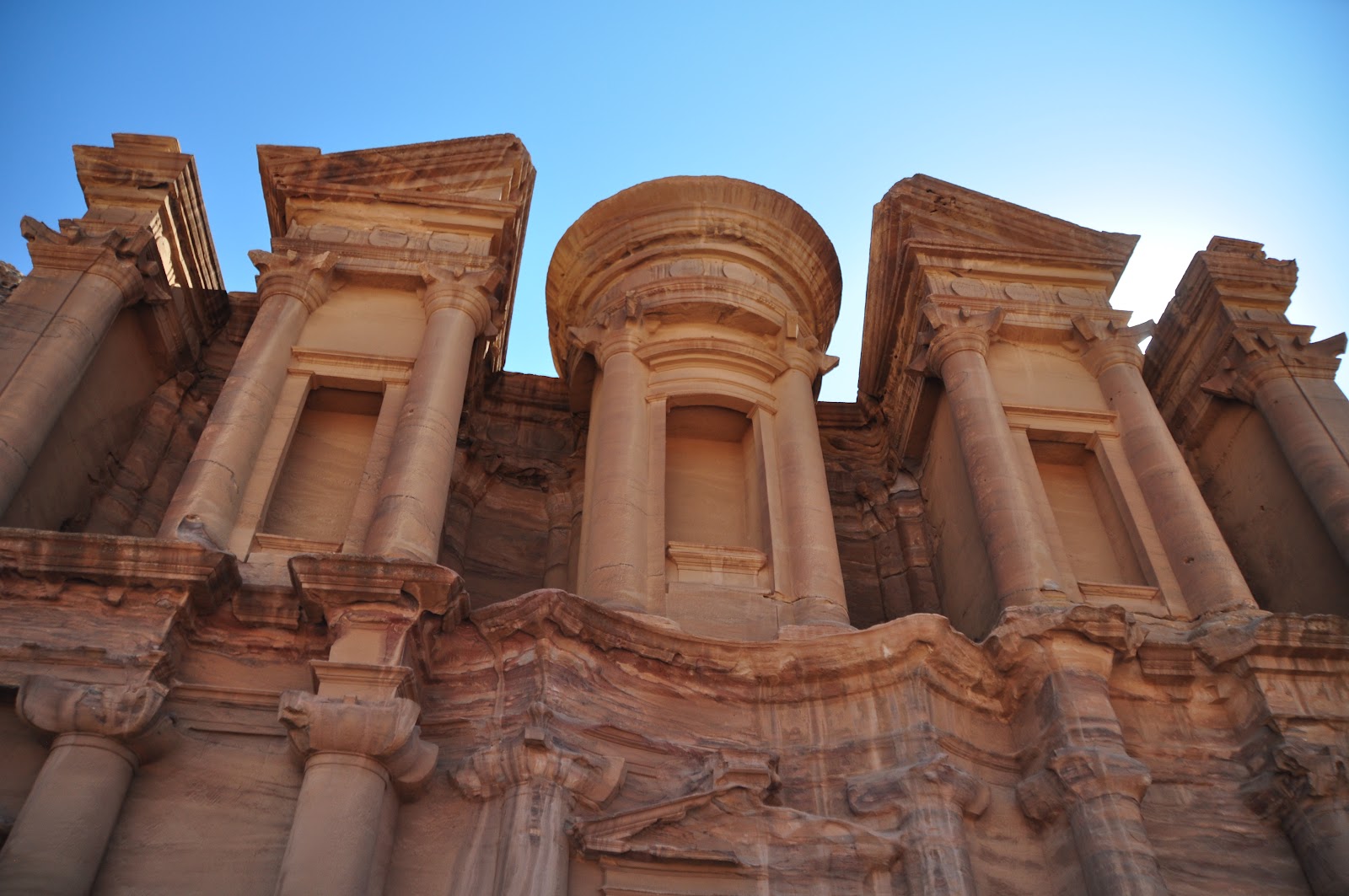
The monastery, or Ad-Deir, is Petra's second most famed attraction, resembling the treasury in design, but dwarfing it in size. With the effort and time it took to visit it, I could just imagine the blood, sweat and tears it took to construct it.


Truly humbling.

For the rest of the day, we took our time exploring the city and enjoyed the incredible relief created by the sandstone. It is hard to believe that the patterns and colours are natural and not from a master's paint brush.


After almost 8 hours at the site, we decided to call it a day.


The following day, we headed to Petra in the late afternoon and made our way towards Jabal al-Khubtha. The trail itself wasn't long, but it was steep and comprised hundreds of stairs. At the top we got an incredible view of central Petra and the surrounding mountains. We followed another trail and were now above the treasury. Simply amazing.


We spent a good hour gazing at this rock-hewn masterpiece before returning to the summit to watch the sunset over Petra.


With its endless array of temples, beautiful and colorful geological formations, and incredible level of preservation, it is no wonder why Petra is now one of the new Wonders of the World.


Although expensive, each time you visit Petra, you find something new: another piece to the puzzle of the mysterious Nabatean civilization and their way of life.

With so many layers of beauty and architectural marvels, can you truly put a price on that?

I think not.