Saturday, October 22, 2011

Dahab Diving, James of Arabia and the Hell which is Hurghada

Dec. 11th-20th

Magdi, needing a break from the urban bedlam known as Cairo, decided that he too, would like to escape to the the Red-Sea coastal town of Dahab, our final destination in Egypt, and sadly, Africa as a continent.

Our overnight coach arrived shortly after sunrise. The brisk sea air and surrounding mountains were a welcomed contrast to the concrete buildings and polluted air we encountered in Cairo. From the bus station, we jumped into a pickup truck taxi and made our way to the beach-front promenade. Once there, Chris volunteered to stay with our bags and Magdi and I went in search of accommodations. The first few places left a little to be desired, and considering this was our final destination, we didn't need to stay in squalour.

After a surprisingly long time, we finally found a place that was reasonably clean and respectably priced. The one caveat was that although we were in Egypt, Magdi, an EGYPTIAN, was not allowed to stay in the same room as Chris and I. Unfortunately, this was the case in many, if not all of the hotels and hostels we checked. Once again, Chris and I, as western Caucasians, had more liberties and rights in a foreign country than a man born and raised there!

Dahab is a laid-back, small town on the eastern coast of the Sinai peninsula. It was a former fishing village, but soon became renown as a scuba diving paradise. Dahab does not have the big-name hotels and resorts found in nearby Sharm el-Sheikh, and because of this, it thankfully appeals to backpackers rather than rich European tourists. Its beachfront promenade is lined with many restaurants, dive shops, lounges, and flashy souvenir kiosks.

During our first few days in Dahab; Chris, Magdi and I didn't really do all that much. We primarily loafed around our hotel, taking full advantage of the hotel's pillow lounge. I spent many hours there; reading, writing and smoking way too much shisha.

Besides polluting my lungs with delicious fruit-flavoured smoke, I also utilized my alveoli for more constructive purposes: Scuba diving. During our first three days in Dahab, I got to dive four times. The startling proximity of the beautiful reefs to the shore made for time-efficient diving and no boat fuel surcharges!

Despite my euphoria at getting back into the water for the first time since Kenya, a moment that I dreaded was upon me before I could even comprehend it: the departure of Chris. It was December 14th, only 3 days since our arrival in Dahab, and Chris was scheduled to depart for Europe on a new adventure. He would be embarking on a botanical and introspective exploration in the south of France, learning how to cultivate the land and be self-sufficient on a farm.

This moment was six-and-a-half months in the making and almost unfathomable considering all that we had been through over this incredible journey. Many travel companions had come and gone: like Dan, Dora and Chris O.; or Stephan and Meret; or Paul, or the wonderful Birdman, a.k.a. Erik with a 'K', or any of the other countless travelers who shared this incredible odyssey with us. But not Chris. His unwavering presence helped get me through many situations which would have been exceedingly difficult on my own. Our friendship was continually tested and only grew stronger as we experienced this stunning continent.

What was surprising was how casual the goodbye ended up being. I suppose that when you spend nearly 24 hours a day with a person, for a period of over 6 months, a little alone time is not the worst thing that could happen! (Just Kidding). Magdi also ended up leaving a day later, returning to chaotic Cairo.

I was now left to my own devices.

Somehow still having proactive tendencies and a desire to explore, I decided to look into doing some excursions around the area. I had opted to hike Mount Sinai and watch the sunset from its peak, and to visit the extraordinary ancient city of Petra, in Jordan. As for the former, an unfortunate storm ended up ruining my one chance to ascend to its peak, so I would have to leave that for another adventure.

As for Petra, seeing as though I was short on time and long on ambition, I had signed onto an organized tour. I was picked up from my hotel at an ungodly hour in the morning by a man in a pickup truck. He then drove me to a gas station just outside of Dahab, where a coach bus was waiting for me. The bus then drove us to the port of Nuweiba, Egypt. We then went through the port authority, had our passports stamped, and proceeded to get on the fast ferry to Aqaba, Jordan.

The ferry ride was a rather pleasant one. It was also quite interesting to be surrounded by four countries on such a short ferry ride: Egypt, Israel, Jordan and Saudi Arabia could all be seen simultaneously as we crossed the Gulf of Aqaba. From there, we were separated by language spoken, and got on yet another bus in Aqaba. This bus took us to Wadi Musa, the closest city to the famed site.

Along the way, we stopped at a road-side souvenir shop/restaurant. It was pretty astounding to see how expensive Jordan was compared to Egypt. Despite the prices, the break still gave us a brief glimpse at Wadi Rum, or the Valley of the Moon. This beautiful valley was made famous in the 1962 film, Lawrence of Arabia; filmed on location.

We had finally arrived to Petra in the early afternoon. Our guided tour would last an hour-and-a- half and then we would have another hour-and-a-half to explore on our own. Having thought that Petra was merely the beautiful rock facade seen in Indiana Jones and the Last Crusade, I thought that would be more than enough time. However, it turns out that not only is the iconic Al Khazneh (the treasury) located a good kilometer from the visitor's entrance, but that Petra is in fact an entire rock-hewn city, with nearly a hundred different monuments and structures to marvel at and explore!

Petra was first established around the 6th century BC by the Nabataeans. Its location served both as a means of fortification and allowed them to control the main commercial routes that passed through the area.

The city can be reached from the east by the Siq, a natural corridor-like gorge formed by the splitting of sandstone.

As our group exited the Siq, the first monument we encountered was Al Khazneh, or the treasury as it is colloquially known. Year (often estimated between 100BC and 200 AD), and purpose of construction are often debated. Even the name, 'treasury', was only given because of a legend stating that it was once used as a hiding place for treasure. Regardless of time or motivation, one thing is for certain, this structure is truly remarkable. I hope my pictures do it justice.

We continued into the city center and marveled at the other rock-hewn monuments and temples. The natural striations, and vast array of colours of the sandstone, made these already incredible structures even more impressive.

Our guide told us that we were now free to explore on our own, but had to be back at the visitor's entrance in an hour-and-a-half. I tried my best to explore as much as I possibly could, but with the expanse of land covered by the stony city and the distance to walk back to the main entrance, time was definitely not on my side. I tried my best to see all I could, but in the end decided I would rather quality than quantity, and that this, like mount Sinai, would best be left for another adventure. I made my way back to the bus, trying to etch as many details of this magical place into my mind as I could.

The bus then took us to a five star hotel for a buffet dinner. Although this part of the tour cut out some of my Petra time, the food was still quite good. When we were finished eating, I noticed a bright pink light coming in through the bay windows. I went outside with Huey, a Malaysian photographer I had met on the tour, and watched in awe as the sky was illuminated with as many colours as the sandstone of Petra. The pictures I took have not been edited or altered, and amazingly enough, that is what it actually looked like.

This entire region is often mentioned in the Old Testament, and based on this, I would definitely say that this sunset was of biblical proportions! (pun intended).

In between Chris' departure and my trip to Petra, I still found time to go diving several times. I would have liked to explore the Ras Mohammed marine National park near Sharm el-Sheikh, but it was closed due to a shark attack that happened a few days before we arrived.

Fair enough.

In Dahab, I was lucky enough to be paired up with a diving instructor from Argentina named Eduardo. He really helped me hone my skills and I really appreciated the time he took, considering that he was also a paying customer at the dive shop. One of the highlights of the diving was Egypt's Blue Hole, also known as the 'World's most dangerous dive site'.

Its danger lies in divers descending well beyond the maximum recreational diving limits (40m/130 feet), succumbing to nitrogen narcosis (an alteration in consciousness caused by breathing gases at higher pressures), leading to disorientation or confusion and then making critical errors. There are even numerous plaques commemoration many of the divers who have lost their lives at this site. Since our group only descended to a maximum depth of 28m, our dive was no more dangerous than any other around Dahab, and yet eerily beautiful staring down towards the blue abyss, descending over 100m beneath you.

Alas, my final day in Dahab, Egypt, and Africa as a whole was upon me. The ultimate leg of my journey was an overnight bus ride from Dahab to Hurghada: a resort-town overrun by Russians on the mainland's Red Sea coast.

I slept for most of the 12-hour bus ride and arrived in Hurghada at 4 am in the morning. I stepped off the bus and had no idea where I was. A local bar was surprisingly still open and I went in to ask for directions. One patron hailed me a microbus that would take me into the city center. Despite being blatantly over-charged, I was still grateful to be going in the right direction. I was dropped off at yet another unassuming street corner and decided to sit and have a bite to eat. I sat down, ordered a kebab and a coke, and watched the hands of my watch slowly inch their way around the dial.

When it was time to pay for my meal, the owner tried to charge me triple what was written on the menu. We argued for a while and I even showed him that I could read the actual price in Arabic, but to no avail. I was already starting to despise this place.

For the next 2 hours, I walked alone in the dark, up and down the main street in search of somewhere to sit and relax. By 7 am, I finally found a cafe that was open. I had countless cups of tea and sparked by first shisha by 7:30 am, the harsh smoke calming my agitation.

I later found a woman working at a hotel who kindly permitted me to leave my bag behind the front desk. I then was lured into a souvenir shop for tea by a young man who wanted to talk. Before entering, I made sure to repeat that I wasn't interested in buying anything, and he assured me he just wanted to practice his English over a nice cup of chai.

After our tea and conversation, as I got up to leave, he attempted to sell me every conceivable object in his store and when I kindly refused, he then tried to charge me for the tea. I lost it. I started screaming at him and I'm pretty sure I told him to go fuck himself. I had been in Africa for almost 7 months and I had never lost my temper like this. It only took me half a day in Hurghada to realize my furious potential.

The final nail in the coffin was on my way to the airport. Wanting to escape this city before I did or said something I would regret, I hailed a cab and asked to be driven to the airport. I asked him to turn on his meter to avoid a potential dispute upon reaching the terminal, but he refused, telling me that it was a flat-rate fare. Surprise, surprise, when we reached the terminal, that flat rate he quoted me had magically doubled. I screamed at him, flailed my arms like a crazy person and even got the police involved. The police sided with me!

I had spent nearly a month in Egypt: I had met incredible people; had learned how to order food and read prices on menus; had learned common greetings, how to be polite and how to adhere to local customs. I felt like I had started all over again in Hurghada, and was treated as nothing more than a white tourist with money. The only saving grace was that as the plane left the runway, and the city disappeared beneath the clouds, I wasn't nearly as sad to leave Egypt as I thought I would have been.

I hate Hurghada!

Don't worry Egypt, I still love you.


Saturday, August 6, 2011

Magdi's Cairo and Egypt's Icons

Dec 7th - 10th

Our overnight bus-ride from Siwa to Cairo was more efficient than expected. We stepped off the bus and were standing at the side of an overpass at barely five in the morning. We hailed a cab and were quickly on our way towards Nasr City, the district where we were scheduled to meet our friend Magdi.

As we drove through the darkness, any repose we wished to enjoy was dashed by the unabating honking of our cab driver. Despite the relative lack of other drivers on the road, he still honked at a frequency of at least 10 honks per minute. When asked why he was honking so much, he merely stated that he was just 'practicing'. What we were not aware of at that time, but that soon became quite apparent, was how this cab-ride would serve as our acclimatization to the chaotic energy (and constant noise) that Egypt's capital city, Cairo, is renowned for.

Chris had called Magdi while we were still in the cab, and our groggy host gave the driver directions to his flat. We arrived shortly after and were welcomed by our friend who we had last seen in Uganda's capital city, Kampala, an astonishing 3317 km away.

Magdi was in the process of trying to sell his flat/office, and the sleeping arrangements reflected the sparsity of the remaining furniture. Chris and I grabbed some sofa cushions, set them up in a neat row, and lay down to try to get some sleep. However, Cairo had other ideas, and although it was only 6 am by this point, the traffic already extended as far as the eye could see, and the honking poured in through the open window like a siren blaring, warning of impending doom.

Since the prospect of sleep seemed to be beyond our grasp, we sat and talked to Magdi over some delicious Egyptian tea; and discussed what Chris and I would like to do during our stay in Cairo. Our first order of business was to visit the Museum of Egyptian Antiquities, or the Egyptian Museum as it is commonly known. After grabbing a quick bite to eat, we were soon on our way.

Our microbus dropped us off in Tahrir Square, the now infamous square where the world watched as the 2011 Egyptian Revolution unfolded. At this time, the square represented nothing more to us than a large, open area surrounded by office buildings and chaotic traffic, right in the city center.

We walked towards the reddish-pink building and found the entrance of the museum to be swarming with tourists. To my dismay, I had to check-in my camera because no photography is allowed within the building. I just prayed that it would still be there upon my return.

We spent several hours wandering through the expansive rooms and vast corridors. The sheer amount of relics, statues, and ancient artifacts was overwhelming. I tried to read as many of their descriptions as possible, but I soon gave up. There was far too much to read.

Out of the all the exhibits from all the pharaonic dynasties, I found the most impressive to be that of King Tutankhamun's, or King Tut's tomb. They practically devoted an entire wing to the contents found within his burial chamber. King Tut's tomb had been discovered accidentally in 1922 by Howard Carter and was one of, if not the most intact tombs ever discovered. This meant that nearly all of the treasures and riches that he was buried with were still present upon its discovery. The most impressive and iconic item was the young King's solid-gold burial mask. To see it in person, gave one a sense of how opulent the Pharaohs were and how divine they were considered.

After our day at the museum, we wandered around the streets of central Cairo, enjoying tea, shisha and some well-deserved kushari: an Egyptian pasta-like dish made with macaroni, lentils and tomato sauce. Aside from the frequent traditional Egyptian breakfast of ful: cooked and mashed fava beans served with olive oil, chopped parsley, onion, garlic and lemon juice; we ate very little Egyptian fare in Cairo. Magdi lived near a cheap and quite delicious Thai restaurant and we pretty much ate dinner there for a majority of the nights we were in Cairo.

Some of the other activities we did while there were wander around Old Cairo and Islamic Cairo at night. Aside from the ancient buildings and numerous mosques, it reminded me of Montreal due to pretty much everything being under construction and the scaffolding lining the streets. In Islamic Cairo, we also visited Khan el-Khalili, a major souq, or market, and got lost in the many winding streets and attractive shops.

We were nearing the end of our stay in Cairo and we still hadn't visited what most tourists come to the country in order to see: the mighty Pyramids. Magdi had managed to borrow his nephew's car and we set off to see these iconic structures. Rather than starting off with the Great Pyramids of Giza, we had decided to first visit two other sites on the recommendation of our Czech friend, and amateur Egyptologist, Robert.

As we drove along the Nile to our first destination, we saw landscapes of palm trees and sand dunes to the west, which were flanked by numerous pyramids, jutting out towards the heavens as they have for millennia. Simply stunning. And ridiculously distracting. I'm glad I wasn't driving!

Our first stop was Dashur, located only 40-kilometers south of Cairo. Dashur is the site of two of the oldest, largest and best-preserved pyramids in all of Egypt. They were constructed by the Pharaoh Sneferu and are known today as the 'Bent Pyramid' and the 'Red Pyramid' respectively.

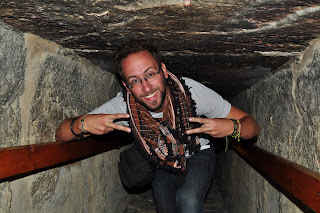
We first made our way to the Red Pyramid. Much like the Great Pyramids in Giza, you can enter into its deep inner chambers, descending nearly 200 feet. But unlike the Great Pyramids, the lack of thousands of tourists with the same idea, made this experience that much more novel, and peaceful. We spent several minutes in the inner chambers before we succumbed to the humidity, and climbed our way back to the entrance. We then proceeded to walk around its perimeter before making our way to the 'Bent Pyramid'.

What is rather interesting about the Bent Pyramid, is that it clearly demonstrates the transition of pyramid architecture: showing the progress from the early step-pyramid design to the smooth-sided design used in the Red Pyramid.

The "bend" results from the change in angle from 55 degrees in the lower portion of the pyramid to the shallower 43 degrees in the upper portion. The newer Red Pyramid was then constructed using only the upper 43-degree inclination, from base to apex, resulting in the smooth-sided pyramid we all know and love.

From there we drove north along the Nile to the Saqarra Necropolis, home to the Pyramid of Djoser. This was ancient Egypt's first pyramid and is believed to be the world's oldest large-scale, cut-stone construction. Built for the Pharaoh Djoser in the 27th century BC, this pyramid marks the beginning of Egypt's pyramidal dynasty. Having no architectural predecessor to base this initial model on, it was constructed completely in a step-pyramid design.

Now that we had visited Egypt's oldest pyramid, and also witnessed the transition from step-pyramid to the smooth-sided pyramid at Dashur, we were now ready to behold the pinnacle of Egypt's pyramidal legacy: the Great Pyramids of Giza.

Magdi didn't want the guards at the entrance asking him too many questions regarding how he knew us and such, so he told me to get into the driver's seat. Then he and Chris went to buy tickets at the ticket-office and the guard just waved me through and motioned where I should park. Being a white tourist in Egypt, you rarely get questioned. So I just drove some random person's car, with no driver's license may I add, into the parking lot of the world's most famous ancient monument, and because I didn't pass through the ticket office, I didn't even have to pay for a ticket!

No matter how many times you see the Great Pyramids on tv, in magazines, or in just about any other form of media, you can still never fathom how impressive and humbling these immense structures truly are in person. Built around 2550 BC to 2490 BC, these prodigious tombs are by far the oldest and only remaining wonder of the ancient world.

I met Magdi and Chris near the ticket office and we walked towards the oldest and largest of the Great Pyramids, that of Khufu (also known as Cheops). Built by the pyramid's namesake, consisting of 2.3 million stone blocks, each weighing between 2.5 and 15 tons, bringing this colossal structure's height to a staggering 481 feet (147 meters).

Chris and I took some time to climb up the side of this herculean tomb, and gain perspective on just how impressive the structure and its construction really were.

Chris and I continued along the man-made road, dodging touters trying to get us to buy camel rides or various other services, until we were now standing next to the Great Pyramid of Khafre. Although Khafre's father, Khufu, had constructed a larger pyramid than his son, 481 ft (147m) versus 471 ft (144m), Khafre compensated like only an Egyptian Pharaoh could: by building his pyramid on a higher elevation and by erecting a giant, man-faced lion (The Sphinx) guarding his tomb!

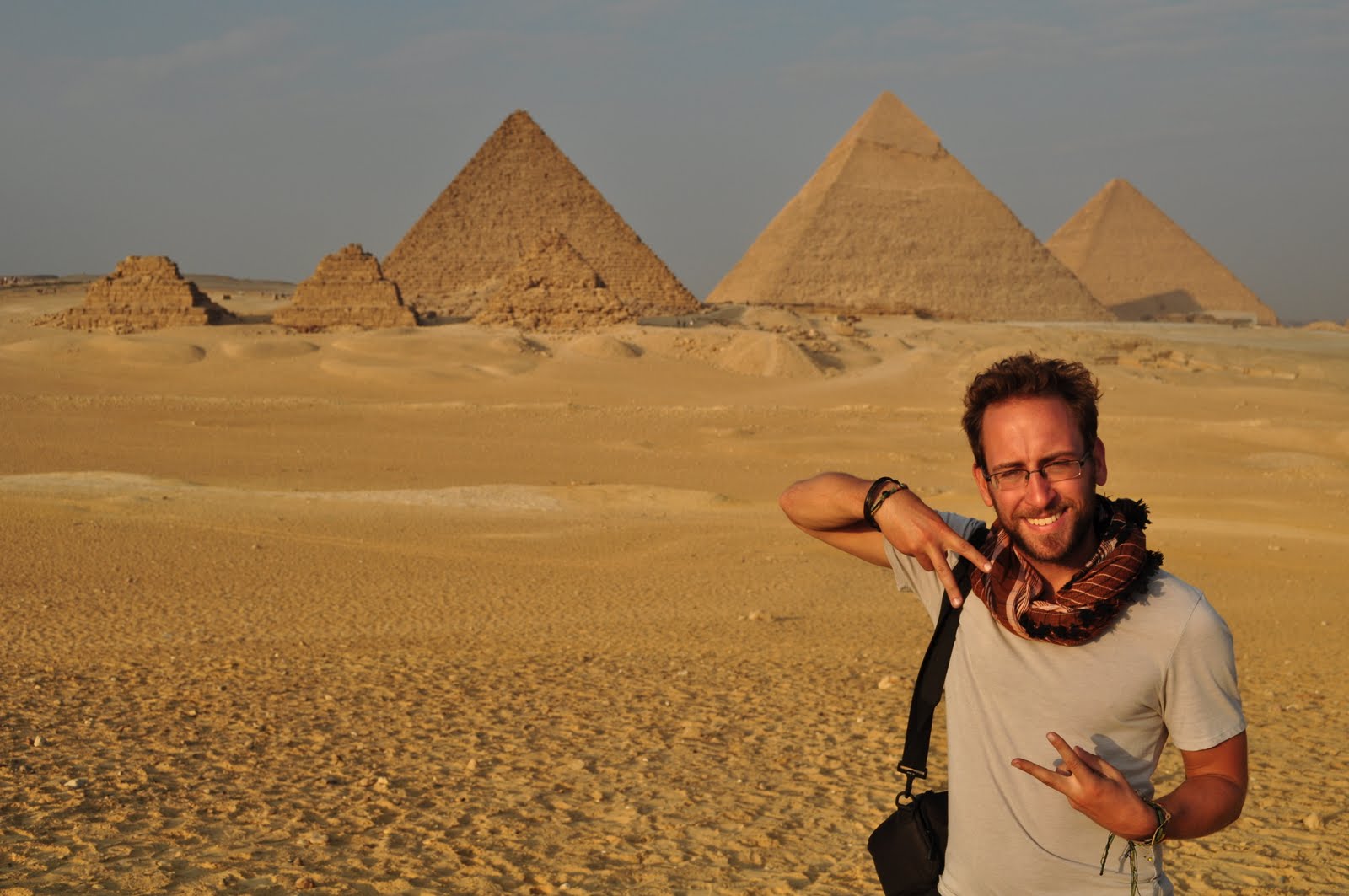
We continued until we reached the third of the Great Pyramids, the pyramid of Menkaure. After seeing all the other astounding pyramids we had seen that day, Menkaure's puny 213 ft (65 meter) pyramid, didn't seem so impressive anymore. So rather than walking around it, Chris wanted a touristy, yet-still-incredibly-alluring, camel-ride near the pyramids, and I asked his owner for the best place to take a picture of all the Great Pyramids together. I made my way there on foot and Chris got a leisurely camel ride.

Once there, we took a few moments to admire the ancient wonder that stood before us and had humbled countless foreigners over the millennia. This vantage point was utterly fantastic and because it was nearing sundown, most of the tourist groups had already left, leaving us with an unadulterated perspective on these immense structures that nearly brought tears to my eyes. We took some pictures together, individually and Chris got a picture with his camel and the touter told us we needed to make our way to the exit before the site closes. Once again he offered to let me share Chris' camel, but I told him I would rather walk. He then challenged me to a race to the Sphinx, which I eagerly accepted, yet ultimately lost.

Once at the Sphinx, the gigantic lion with Pharaoh Khafre's (or so they speculate) face, I waited in an immense line of people trying to get a glance of the iconic statue as the sun descended in the sky behind the Great Pyramids. The wait was more than worth it and despite the thousands of people shouting and taking awkward pictures around me, everything went silent. I felt as if I was alone.

As I made my way back to join my friends, I looked back and saw the Sphinx staring towards the city of Giza, guarding the Great Pyramids as he has been for over 4500 years. With all of the turmoil throughout the Middle-East and the rest of the world, I wondered how long this once inevitable truth would stand. God willing my question will never be answered. At least with any other response than for the rest of time.

One can only hope.


Monday, June 6, 2011

The Blue Ghosts of Siwa

Dec 4th-6th

We exited the bus at around four or five in the morning. I had never really felt the true effects of the desert's lack of heat absorption until that morning. Although I was wearing my skin-tight jeans, a sweatshirt I had bought in Alex that everyone said looked like a Star Trek uniform, and my beloved Maasai Shuka, the near freezing temperatures still chilled me to the bone.

Alex's temperature was much cooler than that of Aswan or Luxor, but it did not compare to this frigid desert air. To make matters worse, we hopped onto a motorcycle taxi (a cross between a motor bike and a rickshaw) and the resulting wind from the driver's speedy driving amplified the cold.

We were let off at our hotel, checked-in, and enveloped ourselves in all the blankets that we had at our disposal. I swear it took a good hour before I stopped shivering. After pseudo-sleeping for a few hours, Chris and I went to go see what our hotel looked like during daylight hours. A simple place, but it had a nice courtyard with wicker chairs and tables. We sat down and enjoyed some breakfast and were quickly acquainted with two Britons: Rohman and Mohammed (probably not his actual name, but I cannot find him on facebook or read his email address, so I will use this Common Muslim name instead).

What is interesting about these guys is that they are the first Western Muslims we have met in the Middle East and to hear there perceptions on Islam, the treatment of women within Islam and how they are viewed and received by Egyptians was quite fascinating. We chatted for a while and agreed that we would meet up for some tea and shisha in the next few days.

The Siwa Oasis is located in Western Egypt, just 50 km east of Libya. It is home to approximately 25,000 people, most of whom are ethnic Berbers. Siwans consider themselves unique to other Egyptians and speak an ancient language, Siwi, as a mother tongue rather than Arabic, which they also learn as a second language in School. The Siwa Oasis was the ancient home of the oracle of Amon, who was famously visited by Alexander the Great prior to his conquest of Persia.

Our first day mainly comprised of us relaxing following our long bus journey. We visited the Siwa tourist office to get a map and ask the curator what he recommends we see during our short stay. By the time our minor errands were complete, it was almost sun down. This being winter, the sun set quite early, around 4:30-5:00pm. I grabbed my camera and we set off to climb the nearby Ancient Fortress of Shali. It took us a few attempts to find the correct passage leading us up to the top of the structure. Once there, we just sat and admired the beautiful scenery around us.

Perched on top of the Fortress, we could see for miles. All around us we could appreciate the lush expanses of palm trees that had been fed by subterranean springs for millennia. Beyond the trees were the copper-coloured Dakrur mountains, saltwater lakes and the tomb-structure of Jabal El Mawta. Beneath us were the centuries-old, mud-brick walls forming an impressive labyrinth below the fortress. Not a terrible introduction to this isolated Oasis that Robert mentioned to us, not bad at all.

The next day, Chris and I had spent a few hours trying to negotiate and arrange a desert excursion for our second day in Siwa. We had a few hours to kill before our truck would arrive, so we decided to climb a nearby hill for yet another spectacular view of this sprawling oasis. Once again, it took us a few wrong turns and some direction-asking, but eventually we managed to make our way to the peak. This hill provided us with a beautiful view of the Shali fortress and we spent an hour or so just admiring the splendid panoramic view of this wonderful place.

The Land Cruiser showed up and we were accompanied by three angry Italians. They were pissed off because there was some confusion regarding the price, time of departure and pretty much every other aspect of their trip. Once the situation was diffused, we started off towards the desert. The first part of the trip was reminiscent of an Arabian makeshift roller-coaster: in that, the SUV would barrel up and down monstrous sand dunes while inducing mild whiplash as we bounced around the truck's cabin. It was a blast, even the cranky Italians had smiles on their faces.

We then made our way to a beautiful cold spring, looking much like a lake situated in the middle of the desert. The turquoise waters and golden grass made it a photographic delight. I did not go in because the water was quite cold and I didn't feel like getting wet or changing sexes. As I was walking around the spring, wandering through the tall grass, looking for the best vantage point to take pictures, I was pretty sure I accidentally broke up a make-out session between two lesbians, hiding from the watchful eyes of our conservative Muslim guides. I felt kind of bad, but at the same time I found it kind of funny.

From there, we continued to a hot water spring that was far more inviting than the cold, scenic quasi-lake we had just visited. Soon after, we made our way to some immense dunes and watched the sun set over the infinite sea of sand. Once the sun had descended, we made our way back to the hotel and were deciding what to do for the rest of the evening.

The store-owner who had arranged the desert excursion for us had another proposition. The owner of a desert guesthouse had invited Chris and I to join him and some other guests for a feast they were having later that night. The owner pulled up in his white pick-up truck and told us to get in. We were with three other men, all dressed in white jalabiyas, (Muslim robes), and white and red keffiyehs, or Arabic scarfs. The pick-up truck picked up speed and before we knew it, we were barreling through the desert at 90 kilometers an hour in pitch darkness. Our driver blasted Arabic music and I couldn't help but smile. At that moment, I could just imagine what our mothers would be thinking if they were to see us in this truck; Arabic music blasting, these men in robes and head-scarfs, an unmarked pick-up racing through the desert: we were being kidnapped by al-Qaeda!

Stereotypes aside, they ended up taking us to the aforementioned desert guesthouse where we passed some Asian tourists sitting by a fire. We went to the back room and one of the men started to prepare some food. Only our driver, the guest-house owner, spoke proficient English, so the broken English-Arabic conversation could only go so far. The food arrived shortly after and we all dug in, quite literally, with our right hands. After our feast, we thanked our host immensely and received a lift back into central Siwa.

The dress I had mentioned before is worn by most, if not all, adult Siwan men. Siwa probably had the largest and best selection of Arabic scarfs that I had seen anywhere in Egypt. The men's wardrobe is pretty typical of that seen in most countries in the Middle East. It is the women of Siwa, however, that are truly unique.

Married women in Siwa wear a particularly interesting attire. All women wear the same blue robe, with subtle white and pink embellishments. The robe provides no allusion to shape or figure and culminates as a hood. What sets this apparel apart from other Muslim attire is the black sheet which covers the face, hiding the very essence and form of the woman's face. Even the Burqa and Niqab expose the eyes. Even though women are seldom seen in public, when they are, they appear as blue shapeless ghosts, floating through the streets or silently sitting on the back of donkey carts as their sons ride them back to their homes.

For the first time in my entire blog, I am going to include a photo not taken by me. I did not take any pictures of Siwan women because I wanted to show them respect and did not feel comfortable photographing them. This picture is from www.travelswithsheila.com.

The following day, Chris and I rented some bikes in order to visit some of Siwa's antiquities. We rented the bikes from our friend who set up our excursion to the desert and although I came to really like the guy, I wish I could have used someone else's bike. This bike made every single push on the pedal excruciatingly difficult and my legs were stinging with lactic acid buildup before we even left the town. This was not going to be fun.

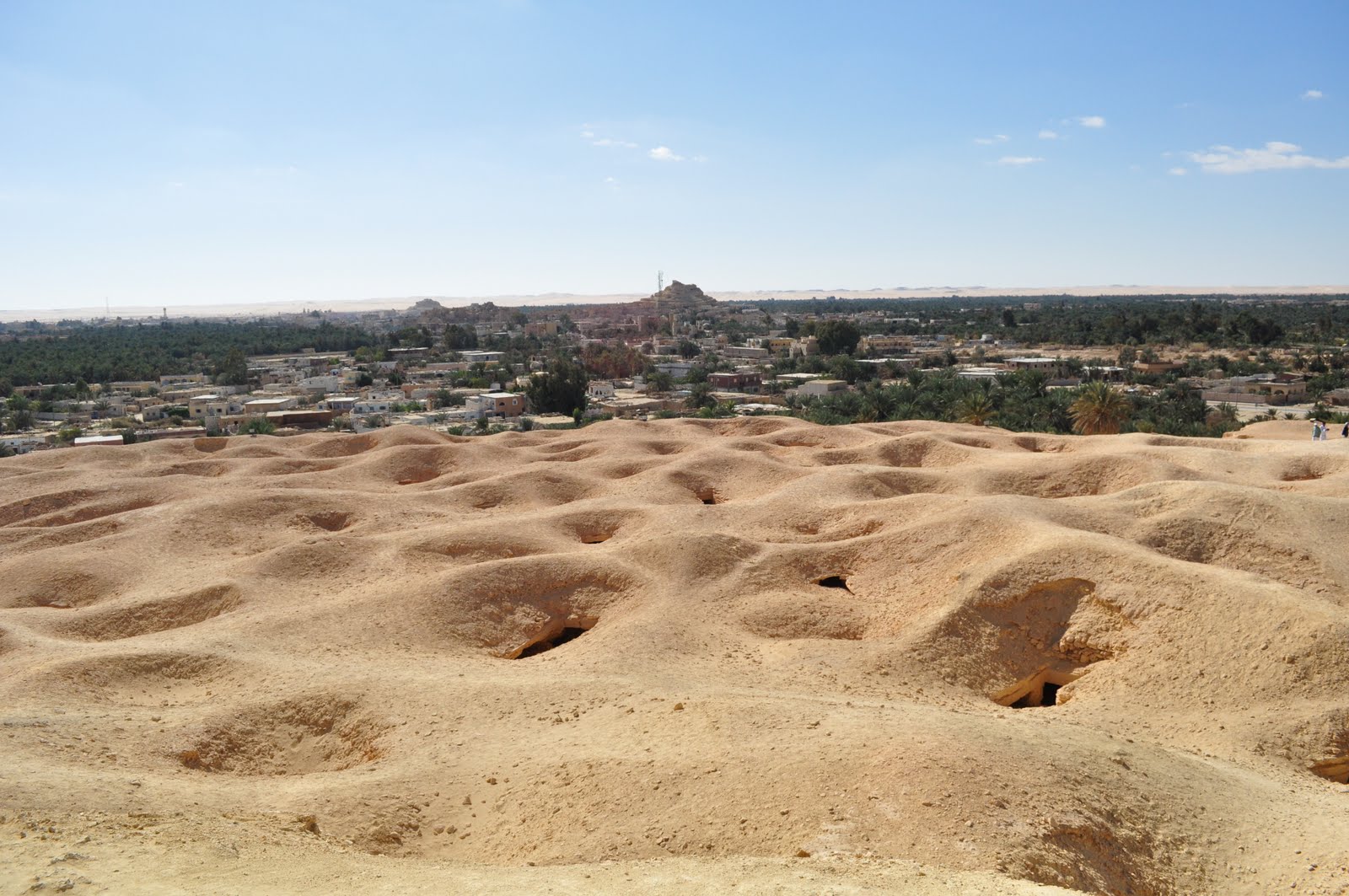
Luckily for me, Siwa and it's surroundings are pretty close together so nothing requires that long of a ride. Our first stop was the Tombs of Jabal el Mawta. These tombs, meaning mountain of the dead, date to the 26th dynasty and had also been used by the Romans. A security guard had to unlock each door in order to show us the underwhelming contents within. I'm allowed to be picky, I've seen the valley of the kings!

Next, we arduously pedaled to the Oracle's Temple, which dates back to the 4th century BC. I must admit that it was pretty cool to climb up the same staircase as Alexander the Great once did, even though I don't really know much about the guy.

We continued to the Temple of Amon, and briefly glanced at the one remaining wall that is still left standing.

Our final stop was Cleopatra's bath, a temperate natural spring that is now surrounded by stone. Not only was it quite refreshing, but it also provided refuge from the hundreds of thousands of flies that were surrounding the pool. After our quick dip, we biked back to our hotel.

We took a short break, clarified directions and quickly made our way to the beautiful Fatnas Islands. Actually a peninsula, this palm-laced beach looks out onto a magnificent saltwater lake and numerous conical mountains. A sunset here could not be missed. We sipped on expensive tea and enjoyed our last moments in this magical Oasis.

We pedaled back before the sun had disappeared completely. I had never been happier to get rid of a bike as I was at that moment. We enjoyed an authentic Berber meal, seated on the floor and then capped our night off with a wonderful shisha and ice-cold coca-cola before boarding our night bus to Cairo.

When I used to think of Oasis, the first thing that came to my mind was "Wonderwall" and a sibling rivalry that was beyond compare. Now I hear the word and am instantly transported to this wonderful desert haven, its incomparable landscape, its kind people, and its mystical blue ghosts.